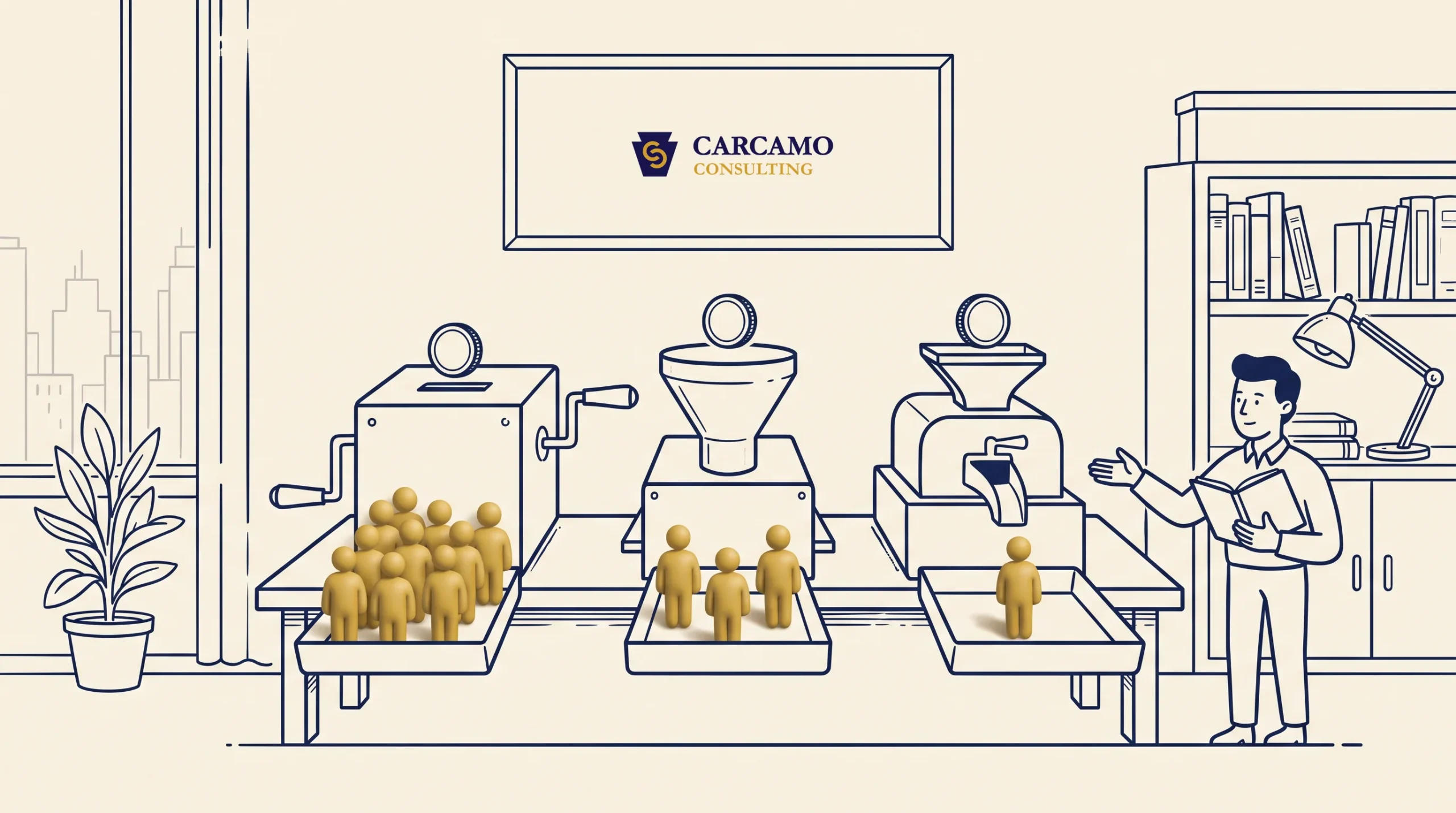

You do not need a video with a million views to get customers. You need a handful of the right people to find something useful you made, trust you because of it, and call when they are ready. That is how content marketing actually brings in customers, and it has almost nothing to do with going viral.
This matters because the viral dream quietly stops a lot of small businesses from ever starting. They picture the overnight hit, decide they could never pull it off, and give up before publishing anything. The good work is much quieter than that, and much more reliable. A steady trickle of helpful content, aimed at the people who could actually buy from you, compounds into a real stream of customers over time.
Why viral is the wrong goal anyway
Going viral feels like the prize. For a small business, it usually is not.
Most of the traffic a viral post brings is the wrong traffic. A clip that entertains a million strangers reaches a million people who were never going to hire a consultant, a contractor, or a cleaner in your town. They watch, they move on, and they never think about you again. Marketers have a blunt word for this kind of visitor: a gawker.
What you want instead is qualified traffic: the smaller number of people who have the exact problem you solve. Fifty of those people are worth more than fifty thousand gawkers, because some of the fifty will become customers.
There is a practical risk too. The rare small business that does go viral often is not ready for it: the phone will not stop, the schedule overflows, quality slips, and the spike fades in a week and leaves nothing behind. A viral moment is a firework. Content marketing done right is a furnace that stays warm.
The difference shows up clearly side by side:
| A viral hit | Steady helpful content | |
|---|---|---|
| Audience | Huge, mostly uninterested | Smaller, has the problem you solve |
| Lifespan | A spike that fades in days | Compounds for months and years |
| Who you reach | Strangers passing through | People close to buying |
| Predictability | Rare and mostly luck | Reliable if you keep going |
| What it leaves behind | Little, once attention moves on | A growing library that keeps working |
Looked at this way, the quiet option is the stronger one. You are not trying to be seen by everyone. You are trying to be the obvious choice for the few who need you.
How content actually turns a stranger into a customer
Content brings in customers through trust, not reach. The path is simple and it repeats:
- Someone searches for help with a problem you happen to solve.
- They find a piece you wrote that answers it clearly and honestly.
- They come away thinking you clearly know your stuff.
- When they are ready to pay someone to handle it, you are the name they already trust.
Notice that none of those steps require a huge audience. They require the right person finding the right answer at the right moment. This is the same engine behind getting customers with content and SEO: publish helpful answers, make them findable, and let the people who need them come to you.
The magic is that helpful content keeps working. A post you wrote six months ago is still answering that question today, still building trust today, still bringing in the occasional customer today. Reach is rented and disappears. Trust is owned and compounds.
What “the right content” actually means
Useful beats clever, every time. The content that brings in customers is not the funniest or the flashiest. It is the most genuinely helpful to a person with a specific problem.
The simplest source is the questions you already answer out loud:
- The things customers ask before they hire you (“how much does this cost,” “how long does it take,” “what is the difference between these two options”).
- The mistakes you watch people make that you could help them avoid.
- The decisions they are stuck on that you could walk them through.
Each of those is a piece of content. Write the honest, complete answer you would give a friend, and you have something that earns trust with the exact people who might become customers. Knowing who those people are matters more than any clever angle, so it helps to first define your ideal customer and write straight to them.
This is also where you have an edge no big brand can copy. You run the business. You know the questions customers actually ask, the mistakes that cost them, the small details that make the difference. A generic writer guessing at the topic cannot match that, and neither can a viral clip built to entertain. Specific, lived-in answers are what make a reader think “these people get it,” and that thought is the start of a sale.
Match the content to where people are
Not everyone who finds you is ready to buy today, and that is fine. Different people need different things, and good content meets them where they are along the customer journey.
- Just learning: broad, friendly answers that build trust and cost the reader nothing.
- Comparing options: content that helps them decide, where you can show why your approach makes sense.
- Ready to act: the practical details that remove the last bit of doubt and make contacting you easy.
You do not need all of this at once. You need a growing mix, so that whoever lands on your content, whenever they land, has a reason to take one more step toward you.
How long it takes (the honest version)
Content marketing is slow before it is fast. For most small businesses, the first real traction shows up around three to six months in, and it builds from there as more of your pieces start ranking and getting found.
That slow start is exactly why it works as a long-term advantage. Most people quit in the quiet stretch. The ones who keep publishing through it end up owning the search results their competitors abandoned. The patience is the moat.
So judge it on the right timeline. The wrong question is “did this post go viral this week.” The right question is “are we steadily building a library of helpful content that more of the right people find every month.” One brings a spike. The other brings customers, for years.
The minimum cadence that actually works
You do not need to post every day. You need to publish consistently, and consistency at a small scale beats a burst followed by silence.
For most small businesses, the minimum that works is one genuinely useful piece a week, or two to four solid pieces a month. That is enough to keep building your library and your trust without burning you out or pulling you away from running the business.
Three rules keep it sustainable:
- Quality over quantity. One thorough post that fully answers a real question will outperform five thin ones. If you only have time for one good piece, write the one good piece.
- Consistency over intensity. A steady once-a-week beats ten posts in January and nothing after. The compounding only happens if you keep showing up.
- Answers over noise. Every piece should solve something for a real person. If it does not help anyone, it will not bring anyone in.
If a weekly piece is too much right now, a strong twice-a-month rhythm still works. The number that does not work is zero.
A realistic first move
If this all sounds doable but you are not sure where to begin, keep it small.
- Write down the ten questions customers ask you most.
- Pick the three that come up the most often.
- Answer one of them properly this week, the way you would explain it to a friend.
- Publish it, then do the next one next week.
- Keep going long enough to get past the quiet stretch.
That is content marketing. No viral hit required, no studio, no following to start. Just useful answers, published steadily, found by the right people over time. When you want to see how this fits with everything else that brings in customers, the broader playbook for getting customers lays it all out.
Frequently asked questions
Does content marketing actually work for small businesses?
Yes, when it is consistent and genuinely helpful. It works differently from ads: instead of buying attention now, you build a library of useful content that the right people find over time and trust enough to hire. It rewards patience and consistency more than budget, which is exactly why it fits small businesses well.
Do you have to go viral to get customers?
No. Most businesses get more long-term traffic and sales from content that never goes viral than from anything that does. Viral content reaches a huge, mostly uninterested audience. Customers come from reaching the smaller group of people who actually have the problem you solve, and that does not require a viral hit.
How long does content marketing take to bring in customers?
Expect the first real traction around three to six months in, building steadily after that as more of your content gets found. The slow start is normal. The businesses that keep publishing through the quiet early stretch are the ones that win, because most competitors quit before the compounding kicks in.
How often do I need to publish to see results?
For most small businesses, one genuinely useful piece a week, or two to four a month, is enough. Consistency matters far more than volume. A steady weekly rhythm of helpful posts will outperform a burst of content followed by months of silence.
Is content marketing worth it if I have no audience or following?
Yes. Content marketing does not depend on an existing audience the way social posting does, because people find your content by searching for the problem it solves, not by already following you. You start earning trust with strangers from your very first helpful post.
When you are ready to turn your know-how into content that quietly brings in customers, Carcamo Consulting can help you figure out what to write and how to get it found, in plain English, with no judgment. If you are not sure where to start, send us your questions and a real human will help you map it out.
 Previous