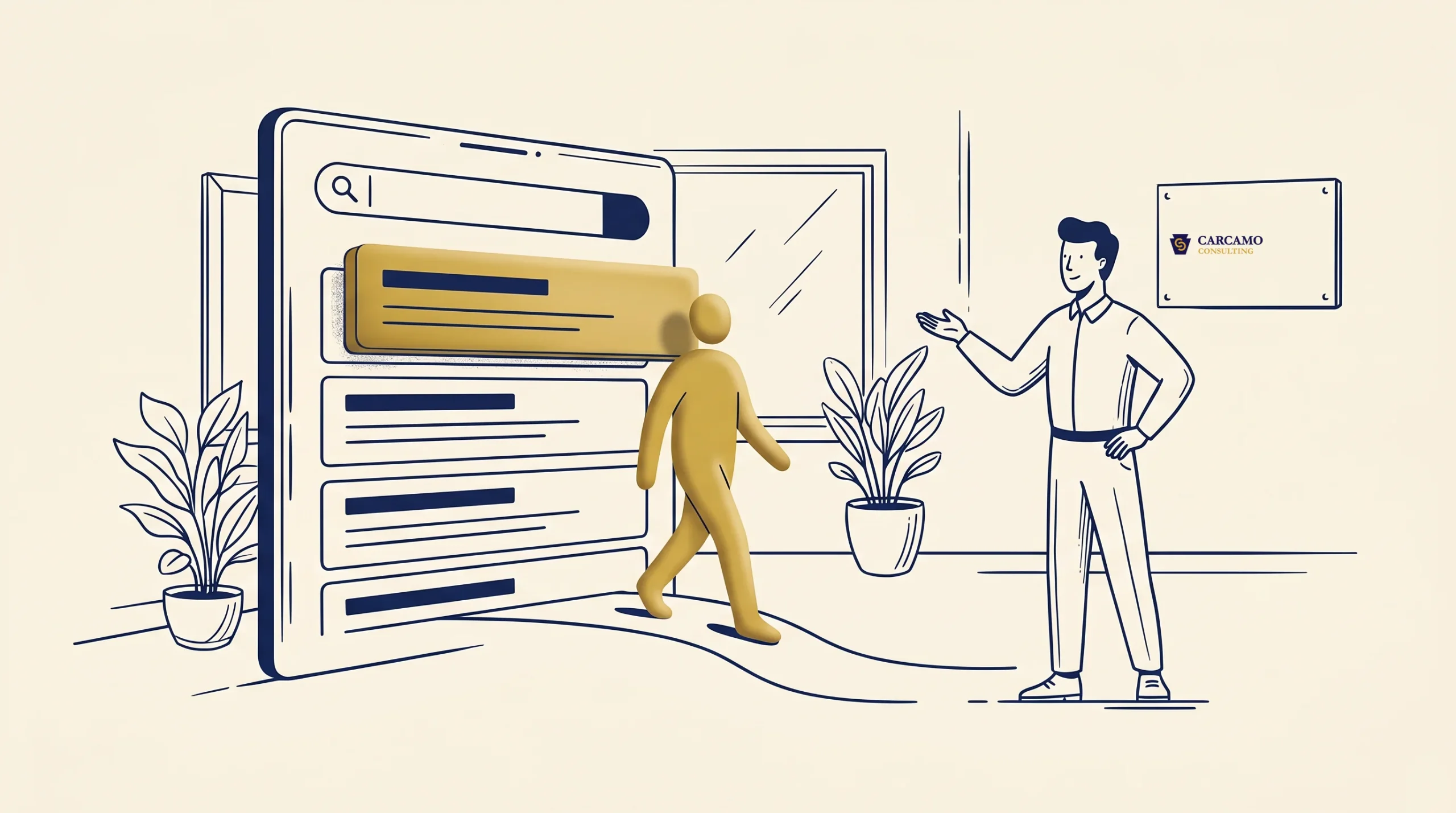
When someone needs what you sell, they type it into Google and pick from what comes up. SEO is simply the work of being one of the options that comes up. Do it well and a steady stream of people who are already looking find you on their own, with no ad spend. That is SEO for getting customers, and the good news for a small business is that it comes down to a short list of moves, not a hundred.
If you have ever searched your own business and felt invisible, this is the fix. The point here is not to turn you into a technician. It is to show you how people actually find you on Google, and the handful of things that move the needle so they find you instead of the competitor down the street.
How Google actually finds and ranks you
Google does three jobs, and understanding them makes every move below make sense.
- Crawl. Automated bots roam the web following links, discovering pages. If nothing links to your page and Google has never seen it, it may as well not exist.
- Index. Google reads each page it finds and files it away, along with what the page is about. Only pages it can read and judges useful get stored.
- Rank. When someone searches, Google sorts its index and shows the results it thinks best answer that specific search, in order.
So getting found is really three smaller wins: be discoverable, be understandable, and be the best answer. Most of SEO is just making those three things true. You do not need to know how the ranking math works. You need to give Google a page it can find, understand, and trust enough to show.
Start with the search, not the website
SEO begins with the words your customers actually type, not the words you would use. Those phrases are called keywords, and matching them is half the battle.
The mistake small businesses make is chasing broad, generic terms. You will not outrank national brands for “marketing” or “cleaning.” You can win the specific searches:
- Long-tail phrases of three or more words, like “emergency furnace repair in Scranton,” are less crowded and far easier to rank for.
- Buyer-intent phrases signal someone ready to act (“hire,” “near me,” “cost,” “best”), and those are the searches worth winning.
- Question phrases (“how much does X cost,” “do I need a permit for Y”) match how people actually search and are easy to answer well.
The simplest source of keywords is the questions customers already ask you. Every one is a phrase someone is typing into Google right now.
The handful of moves that actually matter
Most SEO guides hand you a checklist of fifty things. For a small business, a short list does almost all the work. Here is where to spend your effort, in order.
1. Claim and complete your Google Business Profile
For any business that serves a local area, this is the single highest-return move in all of SEO. Nearly half of all Google searches have local intent, and Google answers them with a map pack of local listings right at the top, above the regular results.
Your free Google Business Profile is what gets you into that map pack. Claim it, fill out every field, choose the right categories, add real photos, and keep your hours and services current. For many local businesses, getting this right brings in calls faster than anything else you could do.
2. Answer real questions on your site
Google’s whole job is matching searches to helpful answers, so the most reliable way to rank is to genuinely be the best answer. Google rewards what it calls E-E-A-T: experience, expertise, authoritativeness, and trustworthiness.
You have an edge here that big brands cannot fake. You do the work, so you can write the honest, specific answer to the questions customers ask, the kind of page that reads like it came from someone who actually knows. This is the heart of getting customers with content and SEO: publish the answers, and the people searching for them find you.
3. Get the on-page basics right
You do not need to be technical to cover the fundamentals that help Google understand a page:
- Put the phrase you want to rank for in the page title, the first paragraph, and a heading. Naturally, never stuffed.
- Write a clear page title and description, since that is the clickable result people see in Google.
- Use descriptive headings and short paragraphs so the page is easy to read and easy to scan.
- Link your own related pages together so Google can crawl them and understand how they relate.
4. Make the site fast and mobile-friendly
Most of your customers are searching on a phone, and Google ranks with that in mind. A page should load in about three seconds. Slower than that and roughly half of mobile visitors leave before it even loads, which costs you the customer and signals to Google that the page disappoints. A clean, fast, mobile-friendly site is table stakes.
5. Earn reviews and mentions
Trust is a ranking factor, especially locally. A steady flow of recent, genuine reviews is one of the strongest local signals there is, and it is also what convinces a human to choose you once they find you. Make asking for a review a habit at the end of every job. There is a simple system for turning happy customers into a stream of reviews that bring in more customers from Google.
That is the list. Five moves, in order of payoff. Do these consistently and you are ahead of most local competitors, who do them poorly or not at all.
How long SEO takes (and why patience wins)
SEO is not instant, and anyone promising overnight rankings is selling something. For a local small business making steady improvements, meaningful results often show up in about 60 to 90 days. More competitive terms can take 6 to 12 months of consistent effort.
That slow build is exactly why SEO is worth doing. It compounds. Every page you add and every review you earn stacks on the last, and the gap between you and a competitor who quit after a month keeps widening. The businesses that win at search are simply the ones that kept showing up.
So treat it as a long game with a real payoff, not a switch you flip. The work you do this month pays out for years.
SEO or Google Ads?
A fair question, since ads put you at the top of the same page today. The difference is that ads stop the moment you stop paying, while SEO keeps working after the work is done. Ads buy you attention now; SEO earns you a position that lasts.
For most small businesses the answer is not either-or. Start SEO early because it takes time to build, and use a little paid search to bring in customers while it grows. If you want to weigh the two properly for your situation, here is a closer look at organic versus paid customer acquisition.
Where to start this week
You do not need to do everything at once. You need to start, in order of payoff.
- Claim and fully complete your Google Business Profile.
- Write down the ten questions customers ask you most, and answer the top three on your site.
- Check that your site loads fast and works cleanly on a phone.
- Ask every happy customer for a review, every time.
- Keep adding helpful pages, a little at a time, and keep going.
That is a real SEO foundation, built from things you already know about your own business. When you want to see how this fits with every other way to bring in customers, the full playbook for getting customers puts it all in one place.
Frequently asked questions
How do I get my business to show up on Google?
Two things get you visible fastest. Claim and complete your Google Business Profile so you appear in the local map results, and make sure your website has pages that clearly answer what your customers search for. Google can only show what it can find, understand, and trust, so being discoverable and genuinely helpful is the whole game.
How long does SEO take to work?
For a local small business making steady improvements, meaningful results often appear in about 60 to 90 days, with more competitive terms taking 6 to 12 months. SEO compounds over time, so the longer you keep at it consistently, the stronger it gets. The slow start is normal and is exactly why most competitors quit and lose the ground.
Is SEO free, or do I have to pay?
The core moves are free to do yourself: claiming your Google Business Profile, writing helpful pages, and asking for reviews cost time, not money. You only pay if you hire someone to do it for you or buy tools to speed it up. Unlike ads, the traffic SEO brings in is not charged per click.
Do I need a website, or is a Google Business Profile enough?
A complete Google Business Profile alone can bring in calls, especially for local service businesses, so it is the right first step. But a website lets you answer more questions, rank for more searches, and build trust in ways a profile cannot. The strongest setup is both: a well-filled profile and a site with genuinely helpful pages.
How do I rank in the Google map pack?
The local map results lean on three things: a complete, accurate Google Business Profile, consistent business information everywhere you appear online, and a steady flow of genuine reviews. Get those right and you give Google every reason to show you when someone nearby searches for what you do.
Can I do SEO myself?
Yes, the moves that matter most are well within reach: your Google Business Profile, helpful pages, basic on-page setup, and reviews. Most small businesses can handle these without hiring anyone. Bringing in help makes sense when you want to move faster, target tougher keywords, or free your time for running the business.
When you search your own business and still do not like what you see, Carcamo Consulting can help you fix it, in plain English, with no judgment. We help small businesses in Pennsylvania and beyond show up on Google and turn that visibility into real customers. Send us your questions and a real human will help you map out where to start.
 Previous