
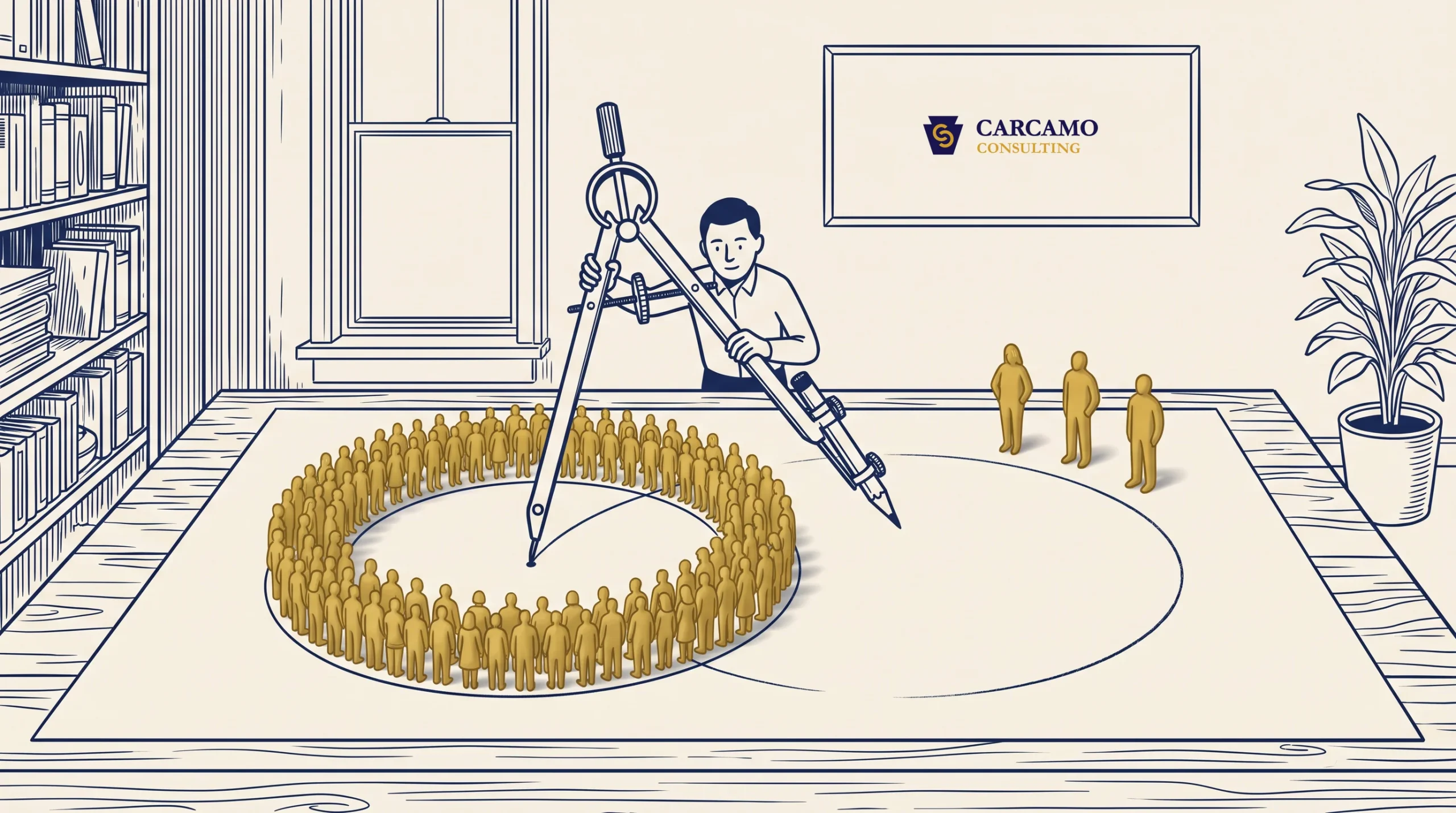
To get customers beyond word of mouth, add channels in order of how close they sit to the trust referrals already give you: borrow someone else’s trust first, build proof that works without you second, and buy attention last. Before you add anything, check that you actually have a demand problem, because a plateau caused by full capacity or underpricing looks identical from the inside and no new channel will fix either one.
A referral engine doesn’t usually break. It fills up. And there’s a number you can work out in about two minutes that tells you exactly how much room yours has left.
First, Check Whether You Have a Ceiling or a Bad Quarter
A ceiling and a slump feel the same in the moment, so separate them before you spend anything.
A slump is a drop. Revenue was at one level, then it fell. A ceiling is flat. Revenue sits inside a narrow band, quarter after quarter, and it won’t break out no matter what you do.
Three quarters inside the same band is the practical test. If your revenue has moved less than ten or fifteen percent in either direction for nine months while you kept working the same way, that’s a ceiling, not a wobble.
Three more signals confirm it:
- Every new customer traces back to somebody you already know. Trace your last twenty. If you can name the connection on all twenty, your reach ends at the edge of your network.
- Referral volume is steady rather than rising. Steady is the tell. A growing business has growing referral counts, because the base producing them is growing.
- People inside one circle know your name, and people just outside it have never heard of you. Ask someone two towns over what they’d search for to find a business like yours, then check whether you show up.
None of those describe a business doing badly. That’s the confusing part. Everything works, it just won’t get bigger.
The Arithmetic of a Referral Ceiling
The reason referrals plateau isn’t mysterious, and you don’t have to take anyone’s word for it. Work out your own number.
New customers per year from referrals is roughly your customers served per year, multiplied by the share of them who ever refer anyone, multiplied by how many each one sends.
Say you serve 80 customers a year. Maybe one in five ever refers anybody, which is a healthy rate, and each of those sends 1.5 people. That’s 80 x 0.20 x 1.5, or 24 new customers a year from referrals.
If you lose 20 customers a year to normal churn, your net growth is four. That’s the ceiling, and it’s arithmetic rather than attitude.
Now look at what happens when you try to push through it. The only lever inside that formula is your own customer count, which means every extra referral has to be paid for by a customer you already won. Referral growth is linear at its very best, and churn eats a slice of it every year. It cannot compound, because the thing producing it is the thing it produces.
This is why working referrals harder stops paying. Once your referral rate is decent, doubling your effort at asking might take you from one in five to one in four. On the numbers above, that’s five extra customers a year. Real, but it isn’t a new stage of business.
None of which makes referrals a bad channel. They’re still the cheapest customers you’ll ever get, they close faster than anything else, and the case for word of mouth as your best value channel holds up completely. The ceiling isn’t a flaw in referrals. It’s just what a channel fed by your own base can do.
Networks also mature rather than expand forever. Customers retire, the person who always recommended you moves companies, a business that sent you three jobs a year gets sold. Your reputation didn’t weaken. The pool holding it simply stopped growing.
Three Plateaus That Look Identical From the Inside
Before you add a channel, make sure the ceiling you’ve hit is actually a demand ceiling. Three completely different problems produce the same flat line, and only one of them is solved by marketing.
A demand plateau means you could take more work and there isn’t more work to take. Your calendar has gaps, you’d say yes to another job tomorrow, and the phone isn’t offering one. This is the only one a new channel fixes.
A capacity plateau means the work exists and you can’t do it. You’re booked out weeks ahead, you’ve turned jobs away this quarter, and you’re quoting long lead times that lose people. Adding a channel here buys you more leads you’ll have to decline, at a cost. The fix is a hire, a subcontractor, better scheduling, or dropping your least profitable service to free up hours.
A price plateau means you’re full at the wrong number. You’re busy, you’re not turning much away, and you’re not making enough. More customers won’t help, because volume isn’t the constraint. Raising your price is, and a business that’s booked out has the strongest possible evidence that it can.
Sorting these takes one honest look at last quarter. How many jobs did you decline or quote so far out that the person went elsewhere? If that number is more than a couple, you don’t have a marketing problem yet. Fix capacity or price first, then come back, because a channel you build while you’re full will produce leads exactly when you can’t serve them.
How to Get Customers Beyond Word of Mouth, in Order
Here’s the mistake almost everybody makes at this point: they pick the channel that sounds most modern, usually ads, and they start there. It’s the furthest possible jump from where they are, and it’s why the attempt so often reads as a failure.
Referrals hand you a buyer who already trusts you. Somebody vouched, the price argument is mostly settled, and your job is logistics. Every other channel starts you somewhere colder, and the further from that warm start you go, the more of your close rate you give up.
So order your next channels by trust distance:
- Borrowed trust. Channels where somebody else’s credibility carries you: partners, communities, and review platforms. Closest to where you already are.
- Earned proof. Channels where your own accumulated evidence does the work without you present: local search, useful content, case studies, an email list.
- Bought attention. Channels where you pay to interrupt a stranger who has no reason to believe you yet: paid ads and cold outreach.
Work down that list, and only skip a rung when you have a specific reason. A business coming off referrals has enormous borrowed trust available and almost never uses it, which is why tier one usually pays first and fastest.
Two boundaries are worth naming and then leaving alone. Adding a second channel also protects you, and what happens to a business that depends on one source of customers is its own argument.
If you want the general framework for weighing any channel on its merits, how to choose an acquisition channel that fits your business covers the criteria. The ladder above is narrower on purpose: it’s about which one to add when referrals are what you’re coming from.
Tier One: Borrow Somebody Else’s Trust
Start here, because it’s the shortest possible step from a referral and you’re already good at the thing it requires.
Partnerships with adjacent businesses are the highest yield move available to most small operators, and they’re structurally the same as a referral except the source isn’t a customer. Find the businesses that serve your customer just before or just after you do.
A remodeler and a cleaner. A bookkeeper and a lawyer. A caterer and a venue. Each one talks to your future customer at a moment when your service is already on their mind.
Make the offer concrete rather than vague. “Send people my way” gets nothing. “I’ll pass you every kitchen job I can’t take, and I’d like the same on flooring” gets an answer, because it’s specific and it’s reciprocal. Five real partnerships beat fifty introductions.
Communities and groups are the second lane: the local trade association, the industry forum, the neighborhood group where your customers already ask each other for recommendations. You want to be the answer people give when somebody asks. That means showing up consistently and being useful without pitching, which is slow and cheap and works.
Review platforms and your Google Business Profile are borrowed trust at scale. They’re the one place a total stranger can inherit the good opinion of people who’ve never met them, which for a local business is often the single highest return item on the whole list.
If you’ve been running on referrals, you probably have dozens of happy customers who’d say something and have never been asked. Getting more reviews from the customers you already have is the fastest version of this to start.
Everything in this tier shares one property. Somebody else has already done the trust building, and you’re plugging into it.
Tier Two: Build Proof That Works Without You
Tier one still depends on people. Tier two is where you build assets that keep selling while you’re on a job.
Local search is the backbone for most small businesses. When someone in your area searches for what you do and has no idea who you are, you want to be there. That’s a claimed and complete Google Business Profile, a website that says plainly what you do and where, and a page for each service you actually want more of. It’s not glamorous and it compounds.
Written answers to the questions you get asked do double duty. Every question a customer asks you on the phone is a question somebody else is typing into a search bar. Answering it properly on your own site earns you strangers, and it also shortens your sales calls, because prospects arrive having read it.
Case studies and before and after proof are what replace the vouching a referral used to do. A stranger needs a reason to believe you, and the closest substitute for a friend’s recommendation is seeing the work you did for someone in their exact situation. Three good ones beat a gallery of thirty photos with no story.
An email list turns everyone who ever considered you into an audience you can reach again without paying for it. For a business with a real customer base already, this is nearly free and almost always neglected.
Tier three, paid ads and cold outreach, is genuinely useful and it is genuinely last. It works best when the tier two assets already exist, because paid traffic lands on your site and then has to decide whether to believe you. Send cold traffic to a thin site with no reviews and no proof, and you’re paying full price for the worst version of your pitch.
Your Close Rate Will Drop, and That’s Not the Channel Failing
This is the part nobody warns you about, and it’s why plenty of owners try one new channel, see disappointing numbers, and quietly go back to waiting for the phone.
A referral closes at a rate that would look absurd anywhere else. Somebody vouched for you, so the prospect arrives already believing, usually not shopping around, and often not really negotiating. When your first search leads or partner introductions come in, they will not behave like that. They’ll ask more questions, compare you to two other options, and take longer to decide.
That isn’t a sign the channel is broken. It’s the trust gap, and it’s the price of reaching people outside your network.
Two things follow from it, and both are practical.
The first is that you have to plan on volume. If referrals close at seven in ten and search leads close at two in ten, you need three and a half times the leads for the same number of jobs. Judge a new channel on booked work per month, never on how each individual conversation felt compared to a referral.
The second is that proof narrows the gap. Reviews, case studies, a real page about who you are, clear pricing, fast responses: every one of those does a little of the job the referrer used to do for free. This is the honest reason tier two matters even while you’re working tier one. Buyers today check you out before they call, even when a friend sent them, so the proof you build serves both channels at once.
Running the Transition Without Dropping the Business
The hardest part isn’t choosing the channel. It’s building one while the old one still has to pay everybody.
Give it a fixed block of hours and defend it. For most small operators, five to eight hours a week is enough to build a second channel over a few months, and it’s small enough to survive a busy week. What kills the attempt is treating it as the thing you’ll do when there’s spare time, because in a business that’s working, there’s never spare time.
Do not slow down on referrals while you build. The plateau isn’t a reason to stop what pays, and the two channels help each other anyway. Keep asking, keep delivering, keep the base warm.
Pick one channel and give it a real trial. Two channels started at once, at half attention each, usually produce two half results and no information. One channel, worked properly for a quarter, tells you something you can act on.
Expect months, not weeks. Partnerships can produce work within a few weeks once a relationship is real, reviews build over a couple of months, and local search usually takes three to six months before it produces steady inquiries.
Start while referrals are still paying the bills. Building under pressure is how owners end up jumping straight to paid ads out of impatience.
And write down where every new customer came from, starting today. In three months that one habit is the difference between knowing which channel earned its place and guessing.
Frequently Asked Questions
How do I know if I have hit a real ceiling or just a slow patch?
A slow patch is a drop from a previous level. A ceiling is flat: revenue sitting inside roughly the same band for three quarters or more while you keep working the same way. The confirming signal is that you can trace every recent customer back to somebody you already know. If both are true, more effort inside your current channel won’t change the number.
Should I stop asking for referrals once I add another channel?
No, and slowing down on referrals is one of the most common ways this goes wrong. Referrals are still your cheapest and fastest closing customers, and they’re paying for the time you’re spending on the new channel. The goal is a second engine alongside the first, not a replacement. Buyers also check you out online before calling even when a friend sent them, so the proof you build helps both.
Which channel should I add first?
Start with the one closest to the trust you already have: partnerships with businesses that serve your customer just before or after you do, plus reviews from the customers you’ve already made happy. Both use the vouching motion you’re already good at, and both produce results in weeks rather than months. Local search is usually the right second move for a local business.
How long before a new channel actually brings in customers?
Partnerships can produce work within a few weeks once a relationship is genuinely established. Reviews accumulate over a couple of months and start affecting who calls you. Local search typically takes three to six months to produce steady inquiries, and written content often longer. Start while your referrals are still healthy, because the timeline is the reason you can’t wait until you need it.
Can I skip all this and just run ads?
You can, and it’s the most expensive way to learn the lesson. Paid traffic sends strangers to your website, and if that site has few reviews, no case studies and nothing that proves you’re good, you’ve paid full price to make a weak first impression. Build enough proof to survive the visit first, then ads become a volume lever instead of a gamble.
Is my business too small to need anything beyond word of mouth?
If referrals fill your calendar at prices you’re happy with, you’re fine and there’s nothing to fix. The question is what happens when your best referrer retires or moves, because that’s when a business finds out how narrow its base was. Building a second channel while the first one is healthy costs a few hours a week. Building one after it slows costs a lot more.
A referral plateau is a strange place to be, because nothing is going wrong. The work is good, the customers are happy, and the number simply won’t move. That’s a structural limit, not a verdict on your business.
The way past it is to reach people your network was never going to touch. Start with the trust you can borrow, build the proof that speaks for you, and give it a quarter. If you want a second opinion on which channel fits what you actually do, tell us what you sell and where your customers come from now.
 Previous