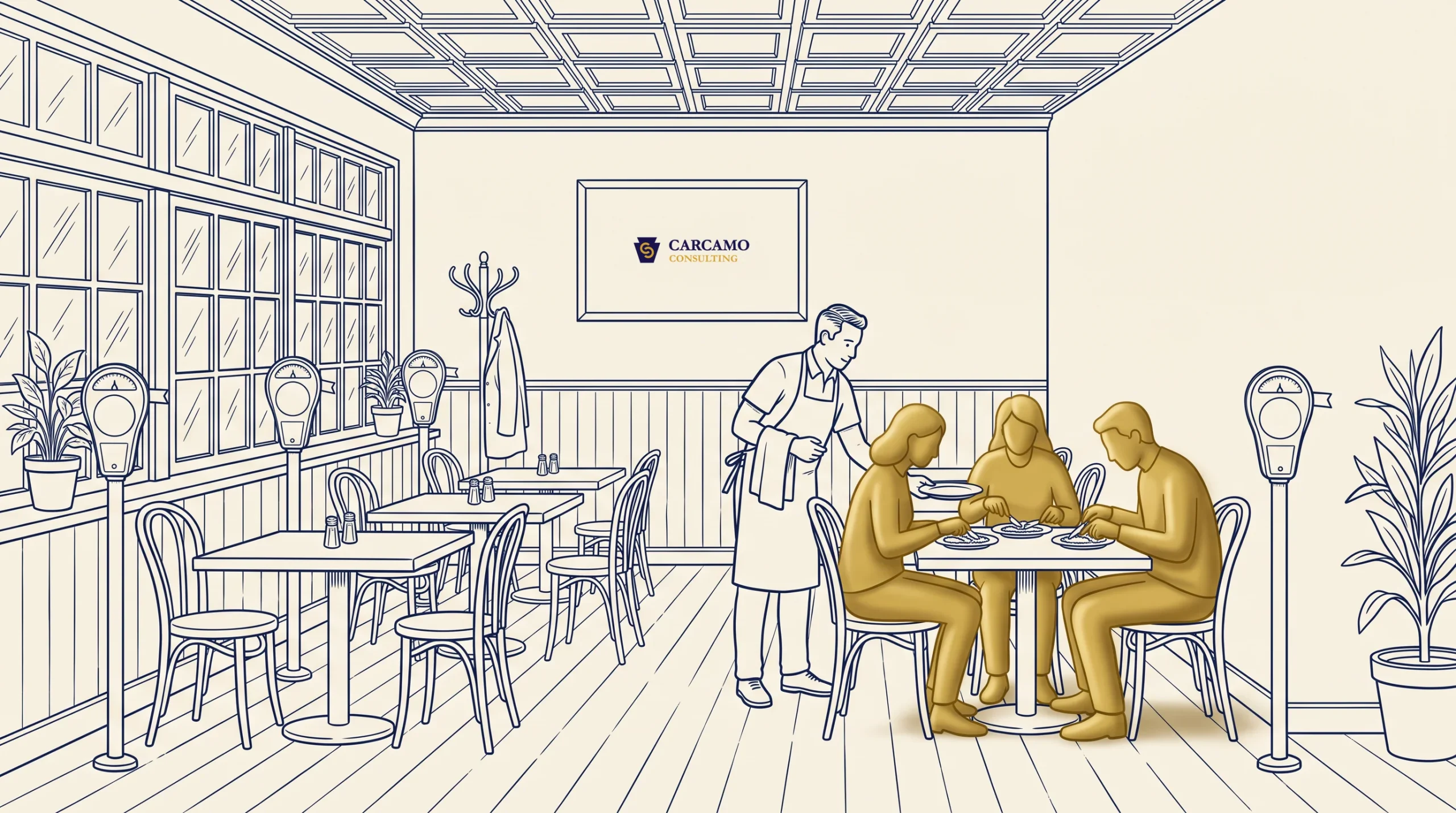
The way to get customers for a restaurant or retail shop is to stop counting customers and start counting hours. Your rent, your insurance, and the crew you scheduled all cost exactly the same whether twelve people come in on a Tuesday or ninety do, and an hour you didn’t sell is gone permanently. So the job isn’t “more customers” in the abstract. It’s filling specific, named hours, and getting the people who already like you to come back sooner.
One number sits underneath every one of those decisions, and most owners have never worked it out. Until you have it, you can’t tell a promotion that made money from one that just made noise.
Why It’s Harder to Get Customers for a Restaurant or Retail Shop Than It Looks
Most advice about getting customers is written for businesses that can sit still cheaply. A consultant with a quiet week loses income and not much else. An online store with a slow Tuesday still has the same inventory to sell on Wednesday.
A business with a door doesn’t work that way, and it’s worth being precise about why.
You pay for the box by the hour. Rent, utilities, insurance, and the people you put on the schedule all run whether anyone walks in or not. Industry benchmarks put occupancy cost alone at roughly 5 to 10 percent of sales for a full service restaurant, and accountants who specialize in the sector treat anything much above 9 percent as a real strain on the business.
Your capacity expires. The table that sat empty at 7pm on Friday isn’t available to sell on Saturday, and neither is the hour your shop stood open with nobody in it. That’s the same economics as an airline seat or a hotel room, and it’s the single biggest thing separating you from a service business.
Each sale carries a thin margin. Full service restaurants commonly land somewhere between 3 and 5 percent net, with a wider 3 to 9 percent band cited across the industry, and quick service usually sits a bit higher at around 6 to 9 percent. At those numbers a badly designed promotion doesn’t dent your profit. It erases it.
Put those three together and the strategy stops being a list of ideas. If the meter is running anyway, the only question that matters is which hours you’re failing to sell and what it’s worth to fill them.
The bounded market argument that applies to every business with a neighborhood still applies to you, and how to win a market you can walk across covers that ground properly. What follows is the part that only applies to a business with a door, a clock, and a fixed monthly nut.
Step 1: Work Out What an Empty Hour Actually Costs You
That’s the number. It takes three inputs and one afternoon, and everything after this step depends on it.
Start with contribution, not revenue. Take your average sale and subtract only the costs that move with it: food and paper, or the wholesale cost of the item, plus card processing. What’s left is what that sale actually contributes toward keeping the lights on.
Say your average check is $22. Food and paper run 30 percent, so that’s $6.60, and card fees take roughly another 3 percent, or $0.66. Your contribution is about $14.75 per customer.
Then add up your fixed nut. Rent, utilities, insurance, base scheduled labor, software, and anything else that bills you whether or not the door opens. If that comes to $11,000 a month and you’re open 26 days, you’re spending about $423 a day before you sell anything.
Divide one by the other and you get your break even: $423 divided by $14.75 is roughly 29 customers a day. Open ten hours, and an empty hour costs you about $42 you’ll never get back.
Now that number does real work. A slow hour that you fill with three customers throws off about $44 of contribution, which covers the hour. And a blanket 20 percent discount cuts $4.40 off every check, dropping contribution to $10.35, which pushes your break even from about 29 customers a day to about 41. That’s 42 percent more volume needed just to stand still, and you’ve handed the discount to everyone, including the regulars who were coming anyway.
Step 2: Rank Every Hour You’re Open
Pull the last eight weeks out of your POS or your register and break sales down by day of the week and hour of the day. Almost every system will do this, and if yours won’t, a tally sheet by the register for two weeks gets you close enough to act on.
Then sort every open hour into one of three buckets:
- Peak hours. At or near capacity. You’re turning people away or making them wait.
- Thin hours. Open, some traffic, running below your break even rate.
- Dead hours. Nearly empty, and costing you the full fixed rate to stay open.
The point of the sort is that these three need completely different treatment, and almost all generic advice mixes them up. Never run an offer that a peak hour customer can use, because you’re paying to serve someone who was already on the way. Every offer you build from here gets locked to a named window: a specific day, a specific stretch of hours.
The size of the prize surprises most owners. A forty seat dining room from 5pm to 8pm on a Tuesday could turn about 60 covers. If you’re selling 15, you’re leaving 45 on the floor, and across 52 Tuesdays that’s 2,340 covers. At $14.75 of contribution each, one weekday window is worth about $34,500 a year.
Step 3: Treat Your Storefront as Media You Already Paid For
You’re renting the most valuable advertising space on your street and most owners use it as storage. Your window, your sign, your lighting, and the first ten feet inside your door reach every single person who passes, and you’re paying for that reach in the rent whether you use it or not.
Count the traffic yourself. Stand outside for fifteen minutes at three different times of day, count the people who pass on foot or slow down in a car, and multiply out. Four hundred a day is 12,000 impressions a month that you’ve already bought.
Then make those impressions do something:
- Put one clear idea in the window, not eleven. A single product, a single price, a single reason, readable at walking speed.
- Light it after dark. An unlit window at 6pm in November reads as closed.
- Post accurate hours where someone standing at the door can read them without a phone.
- Change the display every two weeks so the people who pass daily notice something new.
- Clear the first ten feet inside the door. A crowded entry makes people turn around before they commit.
Every one of those is free or close to it, and attention is the only thing they really cost. Fix the window before you spend a dollar on anything else, because a paid campaign that drives people past a dark, cluttered storefront is just money spent to prove the storefront is the problem.
Step 4: Win the Search Happening Three Blocks Away
Somebody standing two streets over is deciding right now where to eat or where to buy the thing they need in the next twenty minutes. That decision happens on a phone, in a map, and it’s usually settled before they ever see your window.
Three things decide whether you’re in that consideration set, and none of them requires a budget:
- Hours that are correct, including holidays and the days you close early. Wrong hours don’t just lose one visit, they teach someone you can’t be trusted.
- Photos added regularly, showing the room, the counter, and what you actually sell.
- A menu or product list as real text on your own website, not a PDF and not a photograph of a printed page. Search engines and AI assistants can read text. They can’t read your JPEG.
The full mechanics of the profile itself, including the posts and the question section, are covered in getting customers from your Google Business Profile, and it’s worth an hour of your week. Reviews feed the same decision, and the honest way to get them is to ask every satisfied customer at the moment they say something nice to you.
Step 5: Get a Way to Reach People Before They Walk Out
A customer who buys, enjoys it, and leaves without giving you any way to contact them is a customer you have to buy again. That’s the quiet leak in almost every shop and restaurant: the marketing budget goes to strangers while the people who already voted with their wallet walk out anonymous.
Fix it at the counter, where the goodwill is highest:
- Ask at payment, not at the door. “Want me to text you when the next batch comes out of the oven?” beats a clipboard by the exit every time.
- Tie the ask to something real and specific, not to a vague newsletter.
- Keep one list, in one place, that you actually own. A platform that can change its rules on you isn’t your list.
- Send something once a month, whether or not you’re selling. People forget you faster than you think.
Two hundred contacts you can reach directly is worth more than two thousand followers on a platform that shows your post to four percent of them. It’s also the cheapest thing you’ll ever build, because you gather it during hours you’re already staffed and already paying for.
Step 6: Raise Visit Frequency Before You Chase Anyone New
Here’s where the arithmetic gets genuinely surprising. Take 200 regulars who come in once a month. That’s 2,400 visits a year. Move those same 200 people to once every three weeks, and you get about 3,467 visits.
That’s roughly 1,067 extra visits, worth about $15,700 in contribution, from zero new customers. You already know these people, they already like you, and you don’t have to convince anyone of anything.
Frequency moves on small, unglamorous things:
- A reason to come on a specific day, so the visit gets a slot in someone’s week.
- A punch card or simple loyalty setup, which works because it makes the next visit feel already started.
- Remembering an order. Nothing in marketing beats a person saying “the usual?” and meaning it.
- One monthly message to the list you built in step five.
The trade off between winning new people and keeping the ones you have is a real strategic choice, and where to put your energy between repeat and new customers works through it in full. For a business with fixed costs and expiring capacity, frequency is almost always the cheaper side of that trade.
Step 7: Give People a Reason to Come In That Isn’t a Discount
You already saw what a blanket 20 percent cut does to your break even. The deeper problem is what it does afterward, because a discount trains people to wait for the next one and quietly resets what your prices mean. The full case, including the break even table by margin, is in why discounting to get customers can backfire.
A reason works better than a price cut because it’s repeatable, it doesn’t reprice your regulars, and you can aim it at one dead window. Four that hold up:
- A standing weekly thing. Same night, same hour, every week, so it can become a habit rather than an event you have to promote from scratch each time.
- A limited run item. Something that exists this week and not next week, which creates a reason to come now instead of eventually.
- A demonstration or short class. You already have the space and the expertise, and it fills a dead hour with people who are hard to reach any other way.
- A trade with the business next door. Their customers are standing fifty feet from your door, and a genuine swap costs neither of you cash.
Pick one and run it for at least eight weeks before you judge it. Anything aimed at building a habit needs enough repetitions to become one, and the most common mistake is killing a good idea in week three because week three was quiet.
On third party delivery apps, do the arithmetic before you sign. DoorDash publishes partnership plans at 15, 25, and 30 percent commission, plus 6 percent on pickup orders that meet its price matching terms, and Uber Eats publishes a 15 percent Lite plan and a 25 percent Plus plan.
Run those percentages against the contribution figure you calculated in step one. On a $14.75 contribution, a 25 percent commission on a $22 order takes $5.50, which is more than a third of everything you had to work with.
What to Do in Your First 30 Days
Work in this order, because each step depends on the one before it.
- Week one, get the number. Contribution per sale, daily fixed nut, break even customers per day. Nothing else happens until this exists on paper.
- Week two, map the hours. Eight weeks of sales by day and hour, sorted into peak, thin, and dead.
- Week three, fix the free stuff. Window, lighting, hours on the door, and your business profile.
- Week four, run one thing. One offer or one reason, locked to one dead window, plus a way to capture contact details at the counter.
If you’re not sure where you sit, the diagnosis is usually simple. Peak hours full and dead hours empty means you don’t have an awareness problem, you have a scheduling problem, so fill the dead hours and don’t spend on ads.
Every hour thin means the neighborhood doesn’t know you or doesn’t want what you’re selling, and that’s a demand question rather than a timing one. Plenty of regulars but no way to reach them means step five comes before everything else on this list.
Frequently Asked Questions
How do I get more customers into my restaurant when it’s slow?
Pick one slow window and treat it as a separate business. Work out what an empty hour costs you, then build one specific reason to come during that window and only that window, so you’re not paying to serve customers who’d have shown up anyway. Run it for at least eight weeks. A single named night with a real reason beats a general push to be busier.
Do discounts actually bring in new customers?
They bring in traffic, but often the wrong kind and at a price you can’t sustain. A 20 percent cut on a $22 check with $14.75 of contribution pushes your break even from roughly 29 customers a day to roughly 41. Most of that discount goes to people who were already coming. A reason to visit works better and costs less.
Is DoorDash or Uber Eats worth it for a small restaurant?
It depends entirely on your contribution margin, not on your revenue. DoorDash publishes commission tiers at 15, 25, and 30 percent, and Uber Eats publishes 15 and 25 percent plans, so run those against what a sale actually contributes after food and card fees. If commission eats more than half your contribution, treat the apps as paid discovery for new customers rather than as a real revenue channel.
How much should a restaurant or retail shop spend on marketing?
Start from the empty hours rather than from a percentage of sales. If a dead window is worth $34,000 a year in contribution and a campaign to fill it costs $3,000, that’s a good trade even if it looks like a big number in isolation. Most small operators overspend on awareness and underspend on frequency. Fix your free assets first.
What’s the fastest way to increase foot traffic to a store?
Your storefront, and it usually takes a weekend. Clear the window, put one clear idea in it, light it after dark, and post accurate hours where someone at the door can read them. You’re already paying for that visibility in your rent, so it’s the only lever that costs attention rather than money. Correct hours on your business profile is the close second.
How do I turn one time visitors into regulars?
Get a way to reach them before they leave, then give the next visit a specific slot. Ask for a phone number or email at payment, tied to something concrete rather than a vague newsletter, and send one useful message a month. Moving 200 customers from monthly to every three weeks is worth about 1,000 extra visits a year. Remembering someone’s order does more than any app.
Getting customers for a business with a door isn’t really about crowds. It’s about which hours you sell and how often the same faces come back, and both of those questions run through the number you calculated in step one.
Work out what an empty hour costs you, and every decision after that stops being a guess. If you’d like a second set of eyes on those numbers, or on which of your hours to chase first, send us the question and a real person will work through it with you.
 Previous