At 9:14 on a Tuesday night, somebody three towns over types your service and your town into a phone. Ninety seconds later she’s filled in your contact form. Whether she becomes a customer has almost nothing to do with the ad you paid for and almost everything to do with what happened in those ninety seconds and the two days after them.
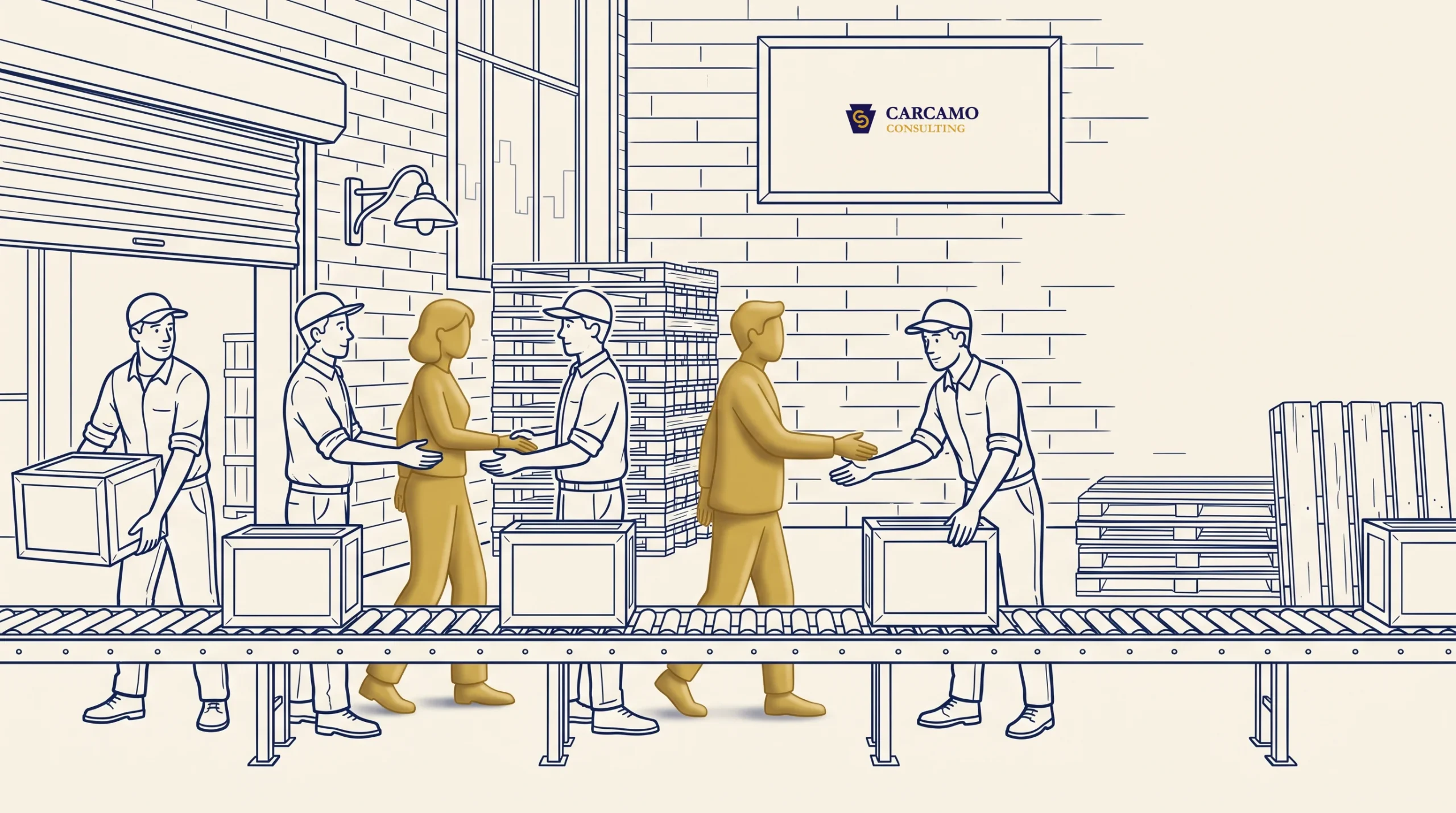
How digital marketing actually works is simpler than the channel lists make it sound. It’s a chain of five systems handing one person along, joined by four handoffs, and almost every failure happens at a handoff rather than inside a system.
The platform passes her to your site. Your site passes her to your records. Your records pass her to a human. And then the last one, which most businesses never connect at all.
That last handoff is what turns the chain into a loop. It’s also the one that decides who the platform brings you next month.
How Digital Marketing Actually Works, in One Pass
Follow her the whole way.
She searches at 9:14pm. Google shows her three ads and a map pack and ten results. She taps yours. That tap costs you $4.80 and appends a tracking code to the end of your web address, which nobody but your systems will ever see.
Your page loads in 1.8 seconds and says the same thing the ad said. She reads two paragraphs, scrolls to the price range, and taps the form. She types her name, her number, and one sentence about her problem.
The form fires a conversion event to your analytics and to the ad platform, and creates a record with her details, the time, and that tracking code.
Your phone buzzes. At 8:40 the next morning you call her back. She books. Three weeks later you finish the job and invoice her for $2,400.
Then, if you have set it up, that $2,400 goes back to the ad platform attached to her original tracking code, and the system that sold you the $4.80 click learns what it was actually worth.
| Step | System | What it hands over |
|---|---|---|
| 1 | Search engine or feed | Attention, priced per click |
| 2 | Your website | A visitor who understood the promise |
| 3 | Your records | A row with a name, a number and a source |
| 4 | A person | A conversation, then a customer |
| 5 | Back to the platform | The real value of that click |
Five systems, four joins. FOUND-01 covers what each of those parts is and why a break in one wastes the other four. This piece is about the joins, because that’s where people get dropped.
What Each Channel Is Actually Doing in the Chain
Channels get taught as a menu, as though you pick two or three the way you’d pick insurance. They’re not alternatives. They sit at different positions in the same chain and do different jobs.
- Search captures demand that already exists. Nobody types “emergency plumber near me” out of curiosity. Search finds people at the moment they’ve already decided to buy something, which is why it converts best and costs most.
- Local search catches the highest intent. It does the same job as search with more urgency: a map pack result serves somebody who wants a business near them, right now, and the click often skips your website entirely and becomes a phone call.
- Paid social creates demand that wasn’t there. Nobody opens Instagram to shop for gutter cleaning. Social’s job is to put a problem in front of somebody who hadn’t thought about it this week, which is slower and cheaper per view.
- Content and organic search widen the top. They catch people researching a problem well before they’re buying, and their real job is to be findable later when the buying moment arrives.
- Email re-reaches people already in the chain. It cannot bring you strangers. Everybody on that list came from another channel first, which is why it’s the cheapest channel and the slowest one to build.
- Your website is the only part that converts. Every other channel just delivers people to it.
Read that as one chain and the budget question changes shape. If nothing is filling the top, more email won’t help. If nothing converts, more search just spends faster.
Handoff 1: The Platform Passes Them to You
What you buy from a platform is a tap. What you need is a person arriving with a promise still intact, and the promise is fragile.
Three things make this handoff work:
- The message survives the transfer. If the ad promised same day service and the page opens with your company history, she has to go looking for what she was promised, and most people just leave. The first screen of the landing page should say what the ad said, in the same words.
- The page arrives fast enough to be read. Every second between the tap and the first readable content is a share of people gone, and you paid for all of them.
- The tracking code survives. That string on the end of the address is how the last handoff will work months later. A redirect that strips it, or a “click here to enter” splash page, quietly cuts the loop before it starts.
The evidence for this handoff is the gap between the clicks your ad platform reports and the sessions your analytics reports. A few percent of drift is normal. Thirty percent is people leaving before the page rendered.
Three of the four handoffs leave evidence like that when they fail. One of them leaves none at all.
Handoff 2: Your Site Passes Them to Your Records
A conversion isn’t a feeling, it’s an event. Somebody stops being a visitor and becomes a row of data with a name, a number and a source attached.
Two failures live here, and they look identical from the outside.
The row never gets created. The form sends an email and nothing else. Emails land in spam, get buried under a hundred others, or go to an address nobody checks on a Saturday. A record in a system cannot be buried, and that’s the entire argument for having one, even if the system is a shared spreadsheet.
The event never fires. The form works, the record exists, and your analytics and ad platform never hear about it. Everything feels fine and every number you use to make decisions is wrong. Tracking is one of the five things that have to be true before any of this can work, and this handoff is exactly why.
There’s a third case that isn’t a failure so much as a blind spot. Somebody reads your number off the screen and dials it by hand. No event, no row, no source.
Work through what that does to your numbers. Say you get 30 inquiries in a month, 12 by form and 18 by phone, and only the form fills are recorded.
Your analytics reports 12 conversions against 600 sessions, a 2 percent conversion rate, and your ad platform calculates cost per lead on those 12. The real rate is 5 percent and the real cost per lead is 40 percent of what you think it is.
You’d be forgiven for switching off a campaign that was actually your best one.
The fix is a tracking number that records the call as an event, or, if that’s a step too far, the discipline of asking every caller how they found you and writing the answer down. The second one is free and works surprisingly well, provided somebody actually does it every time.
Handoff 3: Your Records Pass Them to a Human
Here’s the one that leaves no evidence.
When handoff 1 fails, clicks exceed sessions. When handoff 2 fails, sessions exceed recorded leads. When handoff 4 fails, your customer count exceeds what the platform knows about. Each one is a visible gap between two numbers you already have.
When handoff 3 fails, nothing looks wrong anywhere. The lead record is complete. The analytics show a conversion. The ad platform reports a cost per lead that looks healthy.
The only thing that happened is that nobody replied, or replied on Thursday to a Monday inquiry. There’s no counter anywhere in your stack that increments when a person is ignored.
So you have to build the number yourself. Two habits do it:
- Time stamp the reply. Whatever holds your leads, record when the response went out, not just when the lead came in. The gap is the metric.
- Mark the dead ones. A lead nobody replied to is a different outcome from a lead who said no, and if they share a status you’ll never see the pattern.
The tell that this is your broken handoff is a reasonable cost per lead sitting next to a terrible cost per customer. The leads arrived. Something after them failed, and it wasn’t the ads.
Handoff 4: You Pass the Result Back to the Platform
This is the return leg, and it’s the reason the chain is a loop instead of a line.
An ad platform decides who to show your ads to by learning from what you tell it. If the last thing you told it about was a form fill, it optimizes for form fills, and it will get very good at finding people who fill in forms. Some of those people are tire kickers, price shoppers and wrong numbers. The platform has no way of knowing, because you never told it which ones paid you.
The mechanism for telling it is published and it’s specific. When somebody clicks a Google ad, Google appends a click identifier called a GCLID to your landing page address. You store that identifier alongside the lead. Weeks later, when that lead becomes a $2,400 job, you upload the value back against that identifier, and Google now knows what that click was worth rather than what the form fill was worth.
Meta has its equivalent in the Conversions API, which sends offline and in store events from your systems back to Meta for optimization and measurement.
The part that catches people out is the expiry. Google retains a GCLID for 90 days. Enhanced conversions for leads, the newer version, won’t import an offline conversion uploaded more than 63 days after the last click, and Meta’s guidance for physical store transactions is to upload within 62 days.
Google is also moving these uploads to its Data Manager API from 15 June 2026, so the route changes even though the principle doesn’t.
Read that alongside how long each channel takes to produce a customer and the constraint becomes obvious. If your sales cycle regularly runs past three months, the platform will never learn from your best customers, because the identifier has expired before the money arrives.
The way around it is to upload something earlier in the chain and give it a value. A booked site visit, a qualified appointment, a signed estimate: any of them can be sent back as a conversion with an estimated worth attached.
You lose some precision, since not every appointment becomes a job, and you gain a platform that’s optimizing toward people who show up rather than people who type. For most trades that’s worth making, and it beats the alternative, which is a system learning nothing at all.
Most small businesses never connect this handoff at all. They run ads for a year, teach the platform to find form fillers, and conclude that the leads are low quality. The leads are exactly what the platform was asked to find. This is one thing money genuinely cannot buy you: a bigger budget with no feedback just finds more of the same people, faster.
How to Tell Which Handoff Broke
Five numbers, in descending order, isolate the fault without any new tools. Pull them for the same month.
| Compare | Healthy pattern | If the gap is big |
|---|---|---|
| Clicks to sessions | Within a few percent | Handoff 1: the page is too slow or the link is stripping parameters |
| Sessions to recorded leads | Depends on the offer, but steady | Handoff 2: the form, the tracking, or an offer nobody acts on |
| Leads to replies | Should be 1 to 1 | Handoff 3: nobody is answering, and nothing else will show you this |
| Leads to customers | Varies by trade, but stable | The offer or the follow up, not the channel |
| Customers to what the platform knows | Should be 1 to 1 | Handoff 4: the loop is open and the platform is optimizing blind |
Run those five comparisons once a month and the vague question of whether marketing is working turns into a specific question with one answer.
Here’s what that looks like on a real shaped month. You spent $1,500 and your ad platform reports 310 clicks. Analytics reports 268 sessions, so handoff 1 is fine: the 14 percent drift is normal bot filtering and quick backs, not a broken page.
Those 268 sessions produced 22 recorded leads, a little over 8 percent, which is healthy for a service business. Handoff 2 is working.
Of those 22 leads, your reply log shows 22 replies, but nine of them went out more than a day after the inquiry arrived. Handoff 3 is leaking, and it’s the only one that needed a number you had to build yourself.
Six of the 22 became customers. And the ad platform knows about none of them, because nothing was ever uploaded back. Handoff 4 is open.
So the diagnosis is specific: the ads are fine, the site is fine, the follow up is slow, and the platform is optimizing blind. Two of those are fixable this week without spending another dollar, and neither of them is the thing you would have blamed.
That woman searching at 9:14 on a Tuesday crossed four joins to become a customer, and any one of them could have dropped her without anybody noticing. Knowing which one is broken is most of the job.
Frequently Asked Questions
How does digital marketing work?
It works as a chain of five systems handing one person along. A platform delivers attention, your website converts that attention into a record, and your records hand the person to a human who responds. The outcome is then fed back to the platform so it can find more people like the ones who paid you. There are four handoffs between those systems, and most failures happen at a handoff rather than inside any one system.
What happens after someone clicks my ad?
Their browser opens your landing page with a tracking code attached to the address. If the page loads quickly and matches what the ad promised, they read it and may fill in a form or call. The form should fire a conversion event to your analytics and ad platform and create a record with their details plus that tracking code. That code is what lets you tell the platform later whether this person actually became a customer.
Why am I getting clicks but no leads?
Compare your ad platform’s click count with your analytics session count first. If sessions are far lower, people are leaving before the page loads. If sessions match but conversions are near zero, the problem is either the page itself, meaning the message doesn’t match the ad or the offer doesn’t answer what it costs, or the form is broken and you’re losing leads you never knew arrived. Submit your own form to check which.
How do I know which channel brought a customer?
Analytics tells you the source of the session that converted. That’s accurate for form fills and useless for phone calls dialled by hand. Add a call tracking number, keep the source field on every lead record, and ask every customer how they found you. Expect the three answers to disagree, because a customer usually touches several channels and the last one gets the credit.
What is a GCLID?
It’s the Google Click Identifier, a string Google adds to your landing page address when somebody clicks one of your ads. Storing it with the lead lets you upload the real outcome back to Google later, so it can optimize toward customers rather than form fills. Google keeps a GCLID for 90 days, so anything you want to report has to be uploaded inside that window.
Do I need a CRM for digital marketing?
You need something that creates a durable record of each lead with its source, its date and its outcome. A proper CRM does that well, and a shared spreadsheet does it adequately for a business handling a few dozen leads a month. What doesn’t work is relying on email alone, because an email can be missed and never leaves a countable trace when it is.
 Previous