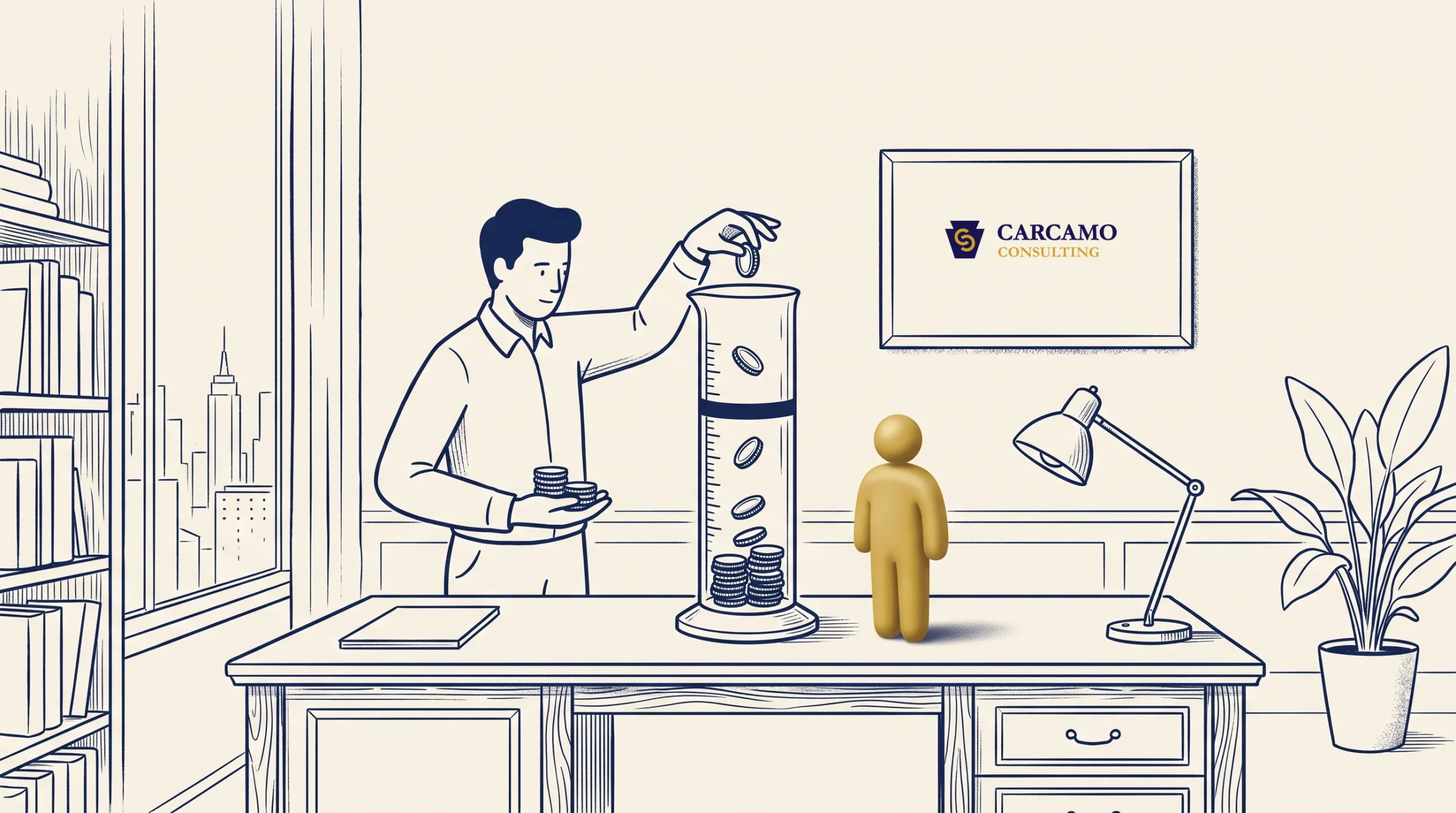
For most local businesses, the answer to how much to spend to get your first paid customers is $500 to $1,500 a month, on one platform, held steady for about three months. That’s enough to buy real data in most service industries, small enough to survive if the first test fails, and it beats every percentage formula you’ll find, because a brand new campaign should be sized to what learning costs, not to revenue you may not have yet.
The interesting part isn’t the number. It’s what that money actually buys at today’s click prices, because once you see the arithmetic, you’ll know exactly why $5 a day fails, why your industry changes the answer, and what to expect from your first thousand dollars before a single customer shows up.
What a Click Costs, and Why It Sets Your Budget
Every ad budget is really buying visits, so the price of a visit is where budgeting starts.
Benchmark reports across 2026 put the average Google Search click at roughly $2.50 to $5.50 across industries, with wide spread around that middle. Competitive, high value services run hotter: legal clicks average north of $8 and can hit several times that in injury law. Most local trades (cleaning, remodeling, repair) sit in the $3 to $8 range depending on the market.
Facebook and Instagram clicks are cheaper, commonly $0.60 to $1.50, with a thousand impressions running about $8 to $14. The catch is intent: a Google clicker searched for you and often needs the service today; a Meta clicker was interrupted mid scroll. Cheaper clicks convert less often, so the platforms end up closer on cost per customer than the click prices suggest.
The number that matters more than either is cost per lead: what you pay for an actual inquiry. Industry benchmarks put the average Google Ads lead around $70, with auto repair and restaurants down near $30 and legal past $130. Facebook leads for local businesses commonly land between $8 and $25.
Those are averages, not promises. Your real numbers depend on your market, your offer, and your landing page. But they’re good enough to budget with, and that’s all a starting budget needs.
How Much to Spend to Get Your First Paid Customers: The Formula
Work backward from customers, not forward from a percentage.
Say you want five new customers from your first real test, you close about half your leads, and leads in your industry run $40. Ten leads at $40 is $400 of pure lead cost. Add room for the learning phase, the ads that flop before one works, and the simple fact that your first month runs worse than your third, and you should plan on roughly double that: $800 to $1,000 for the test.
That doubling isn’t pessimism; it’s the tuition built into every first campaign. Platforms need conversions before their targeting sharpens. Your first headline is rarely your best. The budget has to carry you through that learning, which is why a three month commitment at a steady spend beats a big first month followed by a panicked pause.
There’s also a data floor. You can’t judge a campaign until enough people have clicked, usually 50 to 100 clicks per campaign, and preferably a couple dozen leads. At $4 a click, 100 clicks is $400 minimum just to earn an opinion. Budgets below that floor don’t fail exactly; they just never finish the experiment, which costs the same money and returns no verdict.
Watch the formula work for a commercial cleaning company in northeastern Pennsylvania. A typical office contract is worth $500 a month and clients stay around two years, call it $5,000 profit per customer, so the ceiling per customer is about $1,600. Local commercial cleaning leads run maybe $50 on search, and the owner closes one in three, so a customer costs roughly $150 in ads. That’s a tenth of the ceiling: this business should have started advertising a year ago. Run the same numbers on a $95 one time carpet clean and the case gets thin fast, which is exactly what the formula is for.
You’ll also meet the percentage of revenue rules: the Small Business Administration’s guidance of 7 to 8 percent of gross revenue to marketing for businesses under $5 million, with a slice of that, often 10 to 20 percent, going to paid ads. Those rules are fine for a mature business sanity checking its total marketing line. For a first campaign they’re close to useless: a new business has little revenue to take a percentage of, and a percentage says nothing about whether the resulting number clears the data floor in your click market. Size the first budget to the experiment; graduate to percentages once there’s revenue worth budgeting against.
One more number before you commit: your ceiling. Take your profit on a typical customer and divide by three; never plan a budget whose expected cost per customer exceeds that. Whether you’re ready to pay at all comes down to knowing these numbers cold before the first dollar leaves.
Minimum Test Budgets by Platform
The floors differ by platform because the economics differ.
Google Ads: plan $600 to $1,500 a month, roughly $20 to $50 a day. Search clicks in local service industries cost real money, and Google’s learning phase feeds on conversions. At $20 a day in a $4 click market you’re buying about five clicks a day, 150 a month: right at the data floor, which is the point. Below about $15 a day in most service markets, the campaign spends months in limbo instead of weeks in school. The platform technically accepts far less; the market makes far less pointless.
Facebook and Instagram: plan $300 to $900 a month, roughly $10 to $30 a day. Cheap clicks mean a smaller budget still buys volume: $15 a day at a dollar a click is 450 clicks a month, plenty of data. What Meta needs is conversions per week to optimize toward, so the floor is set by leads, not clicks. If your cost per lead runs $15, a $10 daily budget produces roughly 20 leads a month, enough for the algorithm and for your verdict.
Everything else: not yet. LinkedIn clicks routinely cost more than Google’s with colder intent for local services; TikTok and YouTube want creative volume you don’t have yet. Your first budget belongs on one of the two platforms above, chosen by whether your customers search for the service or discover it. The beginner’s strategy guide walks that choice and the whole first campaign step by step.
If the budget you can sustain sits below these floors, don’t stretch a thin dribble across a year. Save for two or three months, then run a proper six week test at full strength. Same money, an actual answer.
What Your First $1,000 Actually Buys
Spent well, at $25 a day over about six weeks in a typical local service market, a first $1,000 unfolds in three acts.
Weeks one and two, about $350: you’re buying data, not customers. The platform is learning, your ads are unproven, and your cost per lead will look ugly. Maybe 80 clicks, a handful of leads, possibly your first customer. The temptation to pull the plug peaks right here, precisely when the money is doing its most important work.
Weeks three and four, about $350: the tune up pays off. You’ve killed the weaker ad, tightened the geography, maybe fixed the form nobody finished. Cost per lead usually drops noticeably. The same daily spend now buys more: perhaps 90 clicks and twice the leads of week one.
Weeks five and six, about $300: the verdict arrives. By now you have 200 plus clicks and a real lead count. Divide spend by customers won. If that number sits under your ceiling, you didn’t spend $1,000, you bought a machine that turns ad dollars into customers at a known rate. If it sits far over, you bought the second most valuable thing: proof, before you spent $10,000 learning it slowly.
Either outcome beats the alternative, which is guessing. Expect roughly break even economics on the first $1,000 in most local industries; profit usually shows up in months two and three, once the tuning is done and repeat business starts compounding.
What Moves Your Cost Up or Down
Two businesses can run the same budget on the same platform and pay wildly different prices per customer. The levers:
- Industry competition. You’re bidding against everyone who wants the same customer. Emergency services and legal pay the most; niche and low urgency services pay least.
- Geography. Clicks in a metro cost more than in a small market, but small markets have fewer searches to buy. Tight targeting around your real service area cuts waste faster than any bid trick.
- Your offer. “Free estimate this week” outpulls “quality service since 1998” at the same spend. The ad budget rents attention; the offer decides what attention converts.
- Your landing page. Doubling a page’s conversion rate halves your cost per lead without touching the budget. It’s the highest leverage dollar in the whole system, and a landing page built to convert usually costs less than one week of the ad spend it rescues.
- Tracking discipline. Campaigns optimized on real conversions get cheaper every week; campaigns run blind get more expensive. The platforms reward the data you feed them.
- Season. Click prices climb when demand peaks and every competitor piles in. Campaigns started 60 to 90 days before your season buy the same customers at the shoulder price.
Notice that three of the six levers cost nothing but attention. Budget size gets the headlines; budget efficiency wins the market.
This is also why copying a competitor’s budget tells you nothing. The remodeler across town spending $3,000 a month might be paying twice your cost per customer with a weaker page and a vaguer offer, or a third of it with five years of tuned campaigns behind him. The only budget worth benchmarking is the one your own numbers produce, refined by your own results. Spend the first quarter earning those numbers and every later budget decision becomes arithmetic instead of anxiety.
The Mistakes That Burn First Budgets
The same handful of errors eats most first ad budgets, and every one is avoidable:
- Splitting a small budget across platforms. $900 split three ways gives every platform too little data to learn. One platform at full strength beats three at starvation rations, every time.
- The $5 a day dribble. It feels prudent and buys one or two clicks daily, which means the experiment takes most of a year to reach a verdict. Prudence that slow is just expensive procrastination.
- Quitting in week two. The worst numbers of the whole campaign arrive early, while the platform is still learning. Judging the test at its ugliest moment guarantees a false negative.
- Scaling a winner overnight. Doubling the budget the day a campaign turns profitable throws it back into learning and often breaks it. Raise spend 20 to 30 percent at a time and let it settle.
- Judging on clicks. Clicks are the receipt, not the result. A campaign with cheap clicks and no customers is a bad campaign with good vanity metrics.
- No guardrail number. Without a written ceiling per customer, every result feels debatable and the budget drifts. With one, the numbers make the decision for you.
Set Your Number in Ten Minutes
The whole budgeting decision, condensed:
- Write down profit per customer, and divide by three. That’s your ceiling per customer.
- Estimate your lead cost from the benchmarks above ($30 to $70 Google, $8 to $25 Meta for most local services) and your close rate. Multiply into an expected cost per customer. If it clears your ceiling with room, proceed.
- Pick the one platform that matches how customers find you: search it, Google; discover it, Meta.
- Fund it at that platform’s floor or better ($20 to $50 a day Google, $10 to $30 Meta) for three months.
- Judge at six weeks against the ceiling, not against your mood, then kill it, tune it, or scale it slowly.
If the math clears at step two, spend with confidence: the budget isn’t a gamble, it’s a priced experiment with a known worst case. If it doesn’t clear, you just saved the whole budget, and the fix is a better offer or higher prices, not braver spending.
FAQ
Can I run ads with $10 a day?
On Facebook or Instagram, yes: $10 a day buys enough cheap clicks to generate real data in most local markets. On Google Search it’s usually too thin, because $10 buys two or three clicks in typical service industries, stretching the learning phase into months. If Google is the right platform for your service, wait until you can fund $20 a day or more.
How much do Google Ads cost for a small business?
Expect clicks between $2.50 and $5.50 in average industries, $3 to $8 in most local trades, and $8 plus in legal and other hot markets. Leads average around $70 across industries, though auto repair and restaurants often land near $30. A workable starter budget for most local businesses runs $600 to $1,500 a month.
Are Facebook ads cheaper than Google Ads?
Per click, dramatically: often around a dollar versus several. Per customer, the gap shrinks or vanishes, because Google reaches people actively searching while Facebook interrupts people scrolling, and higher intent converts more often. Choose by how your customers find you, not by the sticker price of a click.
Is $500 a month enough to start?
On Meta, comfortably: that’s $16 a day, well above the useful floor. On Google, it’s the thin edge: workable in cheaper click markets, underpowered in competitive ones. If $500 is the whole budget and your service lives on search, consider saving two months and testing at $1,000 a month for a shorter, sharper window.
What percentage of revenue should go to advertising?
The common guidance for businesses under $5 million in revenue is 7 to 8 percent of gross revenue to marketing overall, with roughly 10 to 20 percent of that marketing budget going to paid ads. Treat it as a ceiling check for an established business, not a starting formula: a first campaign should be sized to what a valid test costs in your click market, which is a dollar figure, not a percentage.
How long until paid ads turn profitable?
Plan on roughly break even across the first month while the campaign learns, real improvement in month two, and a fair profitability verdict by month three. Anyone promising profit in week one is selling something. The businesses that win give the test a full quarter at steady spend and judge it with a written cost ceiling.
Budget is the easiest part of paid advertising to overthink and the cheapest to get roughly right. Pick the platform your customers actually use, fund it at its real floor, hold steady for a quarter, and let your ceiling number make every call. If you’d like a second opinion on your numbers before you spend, send them over; we’ve budgeted these tests for our own businesses, and asking us is free.
 Previous