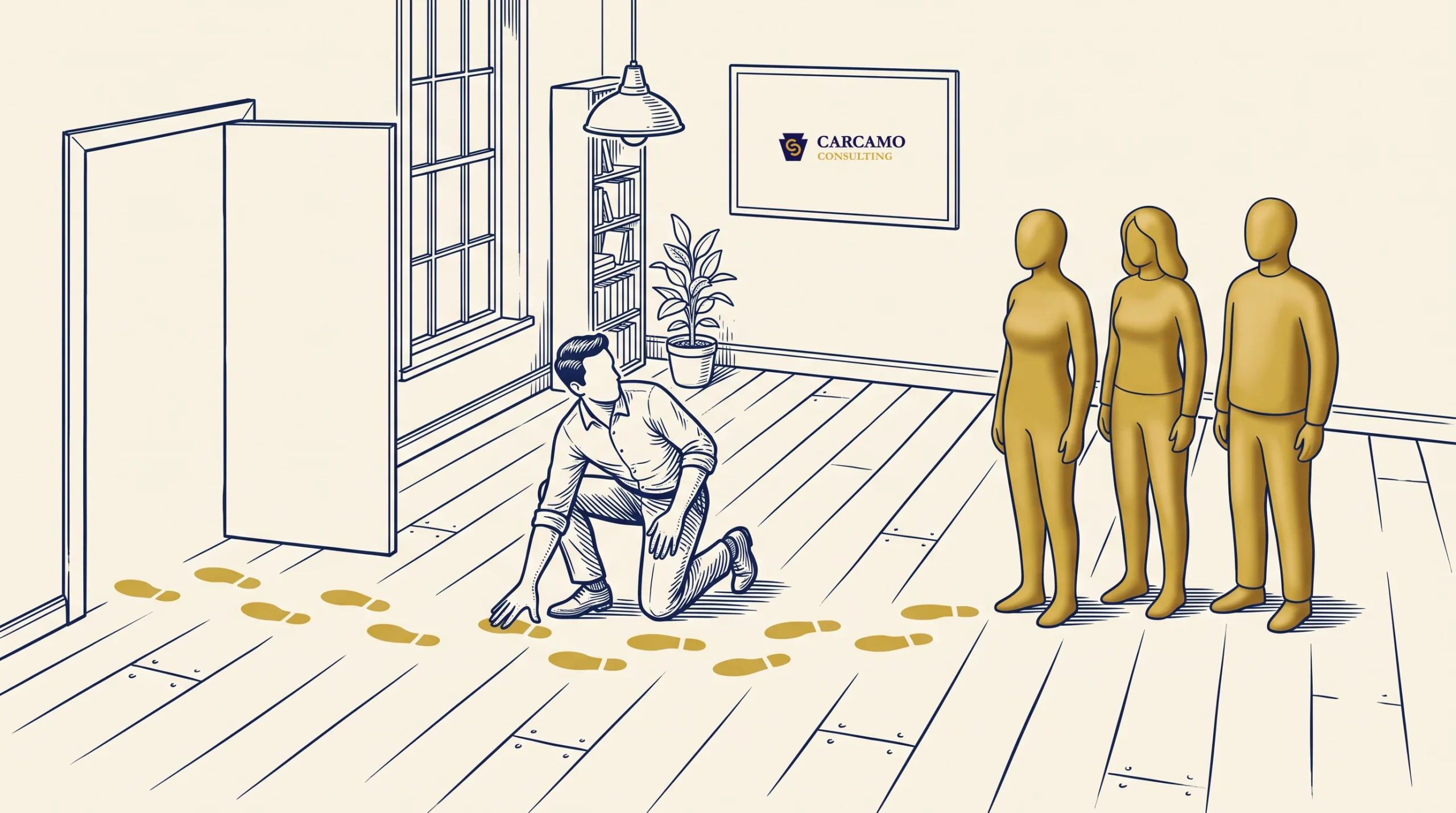

You get customers for a SaaS by recruiting the first hundred by hand, one conversation at a time, and only switching on a repeatable channel once those hundred keep showing up. Founders skip the first half of that sentence constantly. It feels slow, it doesn’t look like marketing, and it’s still the only thing that reliably works before you have a product a stranger can succeed with alone.
There’s also one number that tells you whether you’ve got a marketing problem or a product problem. Almost nobody looks at it before they start spending, and it takes about ten minutes to find.
Why More Signups Can Make a Startup Worse
Every other kind of business has a ceiling that quietly protects it. A cleaning company can only clean so many buildings before the calendar fills. A restaurant runs out of tables.
Software has no ceiling and almost no marginal cost. Serving your thousandth customer costs roughly what serving your hundredth did, which is the whole reason the model is attractive.
Early on, that’s a trap rather than an advantage. Nothing physical stops you from pouring people into something that isn’t ready yet, so nothing stops you from spending the only asset you can’t buy back.
You get to disappoint someone once. A person who signs up, doesn’t understand it, and leaves is not a lead you can re-market to next quarter. They’ve formed an opinion, and in a small niche they’ll share it.
That’s the difference between this and every other playbook in the by business type series. A local plumber who gets too busy turns work away and loses nothing permanent. A startup that gets too many users too early burns through its own market.
Which is why the first move isn’t a channel. It’s a check.
Check Whether They Came Back
Take everyone who signed up last month. Now count how many of them used the product again in the second week. That percentage is the number.
It’s crude, and it’s still more useful than anything in your analytics dashboard, because it separates the two problems that look identical from the outside. Nobody signing up is a marketing problem. Plenty signing up and nobody returning is a product problem, and no amount of traffic fixes it.
Set your own thresholds by judgment rather than by a benchmark, because return rates vary enormously by what the software does. A tool people need daily and a tool people need at tax time cannot be held to the same number.
Run the count as a cohort, meaning one specific group of people tracked over time, rather than as a total. Total active users is the friendliest number in your dashboard and the least honest, because a steady stream of new signups hides the fact that last month’s people all left.
Sign ups in July, still using it in the second week of August. That’s the whole calculation, and you can do it in a spreadsheet.
The rough shape that holds up in practice:
- Almost nobody comes back. Stop spending anything on acquisition. You have a product problem wearing a marketing costume, and every dollar you put into traffic makes the hole bigger.
- A meaningful minority comes back. Something’s working for someone. Find out who they are and what’s different about them before you scale anything.
- Most of them come back. Now acquisition is genuinely your bottleneck, and channels start to make sense.
The arithmetic underneath this is what makes it urgent. If you lose 5 percent of your customers every month, that sounds survivable until you compound it. Multiply 0.95 by itself twelve times and you’re left with 54 percent, which means you shed almost half your base in a year while doing nothing wrong on any individual month.
At that rate, everything you acquire is replacing something you lost. The same energy spent on keeping the customers you already have usually returns more than the same energy spent on new ones, and it does so immediately.
Recruit the First Hundred by Hand
Paul Graham’s 2013 essay “Do Things That Don’t Scale” is quoted constantly and applied rarely. Its central claim is that the most common unscalable thing founders should do is recruit users manually, one at a time, and that this is not a shortcut but the actual work.
The examples he gives are more literal than people remember. Airbnb’s founders went door to door in New York, meeting hosts and photographing their listings to make them better. Stripe’s founders got so used to setting the product up for people on the spot that the practice got a name: when someone agreed to try it, they’d take the person’s laptop and install it themselves.
Both of those look like customer service. They were product research.
Here’s what by hand actually means, and it’s more demanding than sending personalized emails:
- You find the person yourself, from a name rather than a list.
- You get them set up in the product while you’re with them, on a call or in the room.
- You watch where they hesitate and you write it down.
- You fix the worst thing you saw that same week.
- You go back and tell them you fixed it.
That last step is the one people skip, and it’s the one that converts a curious signup into someone who feels like a co-owner.
Manual work has an expiry date. It’s an instrument for learning what your product is missing, not a growth channel. The moment your notes stop surprising you, the research is done and it’s time to build the thing that replaces you.
Where the First Hundred Actually Come From
Nowhere glamorous. Almost never a launch platform, though a launch is fine once you have something to launch into.
The reliable sources, roughly in order of how well they convert:
- People you already know with the problem. Former colleagues, past clients, the two people who complained about this exact thing to you last year. Start here even though it feels like cheating.
- Wherever they complain about it now. The forum, the Slack group, the subreddit, the trade association mailing list. Go to answer questions properly, not to post a link. Ten useful answers buys more than a hundred posts.
- Users of an adjacent tool. If your product exports to something, the people using that something already have your problem shape.
- People currently paying for a worse option. They’ve already proven the budget exists and the problem is worth money, which is two of the three hard things.
- A waitlist you actually talk to. A waitlist of forty people you email personally is worth more than four thousand addresses you never contact.
One warning about communities. Show up as a member for weeks before you show up as a founder, or you’ll get the treatment that self promoters get and lose the room permanently.
Design the Trial Around One Moment
Most trials fail long before the trial ends. Published 2026 trial data shows roughly 29 percent of trial users drop off before day two, with another 14 percent gone between days seven and ten. The decision is made in the first session, and everything after it is a formality.
What predicts the outcome is whether the user reached the point where the product actually did something for them. Benchmark analyses put that activation moment behind roughly 60 to 75 percent of the variation in trial conversion, and users who reach it convert at three to five times the average rate.
So name the moment out loud. It isn’t signing up and it isn’t finishing onboarding.
It’s the first time the product produces something the person wanted: the first invoice sent, the first report generated, the first message scheduled, the first import that worked. Write that sentence down and pin it somewhere visible.
Then build the first ten minutes backwards from it. Everything that doesn’t move the user closer to that moment gets cut, postponed, or done for them.
Doing it for them is legitimate, by the way. Importing their data yourself, setting up their first three records, sitting on a call while they run the thing once: all of that is the manual work from the previous section, aimed at the exact point where people quit.
Charge Earlier Than Feels Comfortable
How you gate the trial changes conversion more than almost anything else you’ll touch, and the published 2026 benchmarks spread wider than most founders expect.
- Opt in trial, no card required. Roughly 8 to 22 percent convert to paid, with a median near 14 percent.
- Opt out trial, card at signup. Roughly 35 to 55 percent convert, median near 44 percent.
- Freemium. Roughly 2 to 8 percent of free users ever pay, median near 4.5 percent.
- Reverse trial, full features first then a downgrade to free. Roughly 18 to 32 percent, median near 24 percent.
Read those numbers carefully, because the obvious conclusion is the wrong one. Asking for a card doesn’t make anybody want your product more. It filters, so you get far fewer trials and a much higher share of serious ones.
That trade is usually right early and usually wrong later. When you have twenty trials a month you need every one of them to be a real prospect you can talk to. When you have two thousand, the filter is throwing away learning you could use.
Work it through with round numbers. Say an ungated trial brings you 200 signups a month and converts at the 14 percent median, which is 28 customers. Put a card at the front and you might see 60 signups instead, converting at the 44 percent median, which is 26 customers.
Almost the same revenue. But you’re now supporting 60 people instead of 200, and 60 is a number of conversations a founder can actually have. That’s the real argument for the card early on, and it has nothing to do with the money.
Free users aren’t free either. Every one of them costs support time, server cost, and attention you don’t have, which is the same reason a startup should care about how quickly a customer pays back what it cost to get them long before it worries about lifetime value.
Charge something, early, to someone. A price is the fastest honest signal you’ll ever get about whether the problem is real.
Only Then Turn On a Channel
Once returning users are the norm rather than the exception, repeatable acquisition becomes the right problem to work on. Content and search bring people who are already looking for a fix. Paid brings volume you can turn off. Partnerships bring borrowed trust.
Each of those is its own discipline, and each one rewards being learned properly rather than dabbled in. What matters at this point is the order, and the order is strict.
A channel amplifies whatever you already have. If your product converts one trial in twenty and holds nobody past week two, a channel gets you a faster version of that. Founders discover this expensively, usually about six weeks into an ad budget.
The timing question of whether to keep going organic or start buying traffic has a real answer that depends on your margins and your patience, and knowing when it’s actually time to start paying for customers is worth settling before you spend rather than after.
How to Get Customers for a SaaS at Each Stage
The tactics above aren’t a checklist to run top to bottom. Here’s what to actually do, based on how many paying customers you have right now.
At zero. Don’t build a funnel. Find ten people with the problem, get them using it in front of you, and treat every point of confusion as a bug. Your goal isn’t revenue, it’s a list of things to fix that you couldn’t have guessed.
At one to ten. Get paid by someone who isn’t a friend. Then interview all of them and look for the one thing your happiest customer has in common that your others don’t. That’s your real ideal customer, and it’s usually narrower and stranger than the one in your pitch deck.
At ten to a hundred. Fix onboarding until the activation moment happens without you in the room. This is the stage where the manual work has to start dying on purpose, one step at a time.
Past a hundred, with people returning. Now pick one channel, give it a fair run of three to six months, and measure it against payback rather than against signups. One channel run properly beats four run casually, every time.
Past a hundred, with people leaving. Go back to the return rate and work on that instead. You don’t have an acquisition problem yet, and treating it as one is the most expensive mistake available at this stage.
If you’re at one of those forks and you’d rather talk it through with somebody who has spent real money on marketing and watched some of it work, that’s what we do. We run our own businesses, so the answer you get is an operator’s, not a textbook’s. Asking a question costs nothing.
Frequently Asked Questions
How long does it take to get 100 SaaS customers?
Plan for several months to a year rather than weeks. The first ten usually come fast because they come from people you know, then progress slows sharply while you fix what those ten showed you. Founders who hit a hundred quickly almost always had an audience or a network before they started building.
Should I launch on Product Hunt to get users?
A launch is worth doing once you have a product people can succeed with alone, and it’s mostly wasted before that. It produces a spike of curious signups, and curious signups without a working onboarding just become people who already tried you. Treat it as a one time amplifier, never as your acquisition plan.
Is freemium or a free trial better for a new SaaS?
A trial converts far better early on, since published benchmarks put freemium free to paid conversion near 4.5 percent against roughly 14 percent for an opt in trial. Freemium only makes sense when free users bring you something valuable, like content, network effects, or referrals. For most early products, a short trial with a real conversation attached beats both.
How do I get SaaS users with no audience and no email list?
Go where the problem already gets discussed and be genuinely useful there for several weeks before mentioning your product. Direct outreach to named people works too, as long as you researched each one. Neither scales, and neither is supposed to at this stage.
Should a startup run paid ads before it has traction?
Almost never. Ads multiply whatever your product already does, so they turn a weak trial conversion rate into an expensive weak trial conversion rate. Wait until returning users are normal and you can name what makes them stay.
What’s a good trial to paid conversion rate?
It depends heavily on how the trial is gated. Opt in trials without a card typically land between 8 and 22 percent, while trials that take a card at signup run 35 to 55 percent. Product led companies average around 22 percent overall against roughly 15 percent for sales led, so compare yourself to your own model rather than to the highest number you read.
 Previous