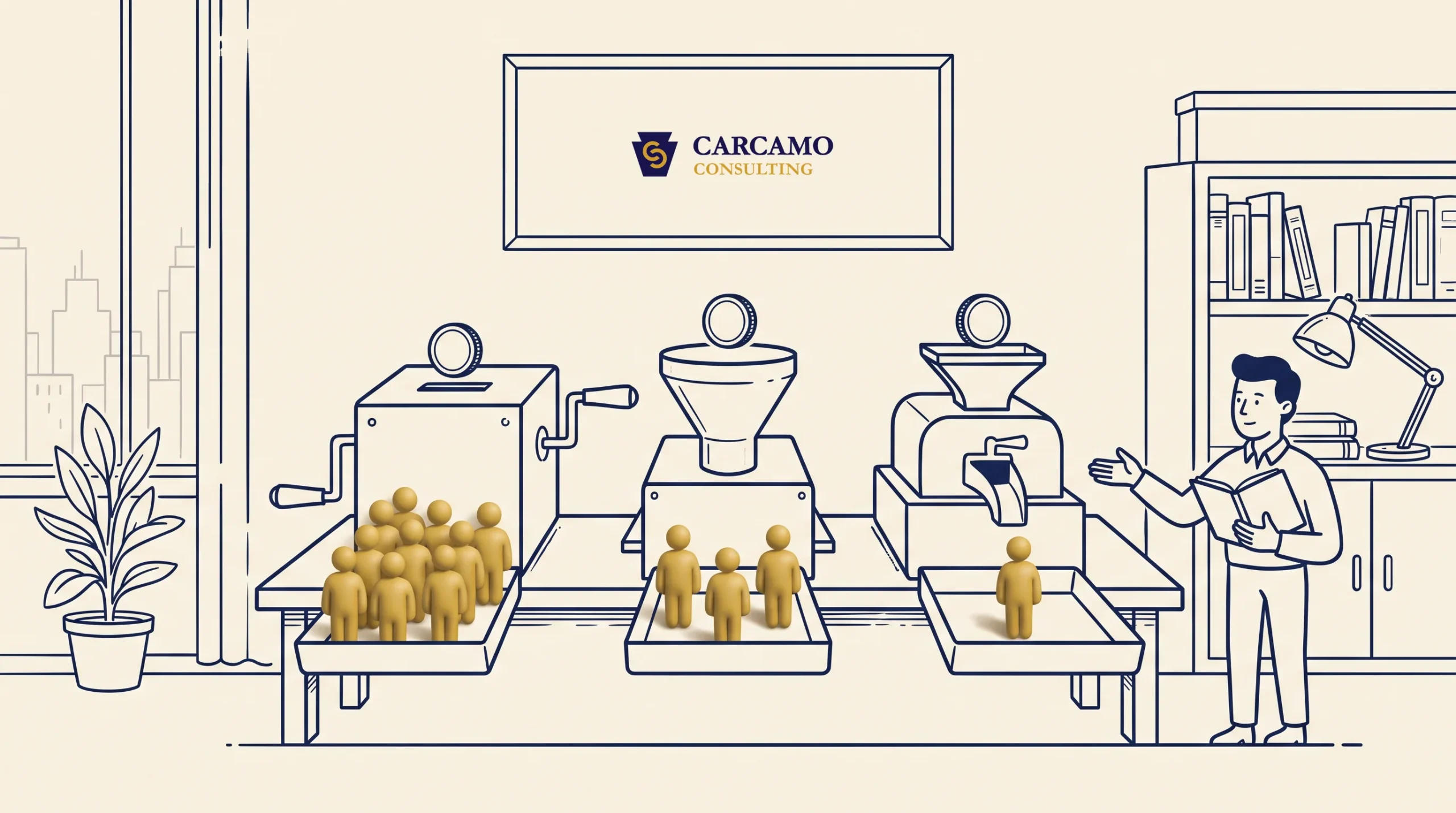

If your ads aren’t getting you customers, the problem lives in one of three layers: the ad (nobody clicks), the page (they click but never become leads), or the close (you get leads but no buyers). Fix the layer that’s actually broken and the whole chain starts working; fix the wrong one and you can rewrite headlines all year for nothing.
Your ad account already knows which layer it is. Three numbers, read in order, point at the broken layer every time, and the third one is a number most owners have never once looked up.
First, Rule Out the Boring Explanation
Before diagnosing anything creative, confirm the ads are actually running and actually spending. A surprising share of “ads don’t work” cases are ads that barely ran.
A remodeler we’ll call typical sets a $300 monthly budget, checks back in three weeks, and declares ads a scam. The dashboard tells a different story: the campaign spent $38, because the audience was set to a five mile radius with three interest filters stacked on top, and the platform could barely find anyone to show it to.
Nothing about that campaign’s creative, page, or offer was ever tested.
Open your ads dashboard and check three things:
- Impressions: if they’re near zero, nothing else matters yet. The usual culprits are a paused campaign, a rejected ad, a billing hiccup, or an audience so narrow the platform can’t find anyone. Meta’s own guidance flags budgets under about $5 a day as hard to deliver consistently.
- Spend: if you budgeted $300 and the platform spent $40, the campaign never got a real test. Delivery problems masquerade as performance problems.
- Time: platforms need a learning period. Meta looks for around 50 conversion events in a week to calibrate an ad set, and Google campaigns typically need weeks, not days, to settle. An ad judged after 72 hours wasn’t judged; it was interrupted.
One more delivery trap deserves a mention: disapprovals that only half happen. A rejected ad inside an otherwise active campaign quietly shrinks your reach while the campaign reports itself as running, so scan for warning icons on every individual ad, not just the campaign row.
If impressions, spend, and time all look healthy, the machine is fine. Now the real diagnostic starts.
Three Numbers Show Why Your Ads Aren’t Getting You Customers
Here are the numbers promised at the top, in the order to read them:
- Click through rate (CTR): of the people who saw the ad, how many clicked? Search ads commonly land in the 3 to 6 percent range, social ads closer to 1 percent. Sitting far below those neighborhoods means an ad layer problem.
- Page conversion rate: of the people who clicked, how many became leads (called, booked, filled the form)? A solid small business landing page converts in the mid single digits, and the best push past 10 percent. Sitting near 1 percent with decent traffic means a page layer problem.
- Close rate: of the leads, how many became paying customers? This is the number almost nobody checks, because it doesn’t live in the ad platform at all. It lives in your inbox, your voicemail, and your quote follow ups. If you’re closing fewer than roughly one in five real leads, the ads are working and the close layer is where customers are dying.
Getting the third number takes ten minutes with a notepad: list last month’s leads, mark which ones you actually spoke to, and mark which ones bought. Most owners doing this for the first time discover they never reached a third of their leads at all, which reframes the entire “ads don’t work” complaint before a single setting gets touched.
Read them strictly in order and stop at the first bad number. That’s your broken layer, and only that layer is worth fixing this month. The three sections below take them one at a time.
Nobody Clicks: Fixing the Ad Layer
A low CTR means the ad is reaching people and leaving them cold. Three causes account for most of it.
The ad is about you, not them. “Family owned since 1998, licensed and insured” is a fine footer and a terrible headline. The ad’s first line has to name the reader’s problem or desired outcome: “Kitchen looking tired?” beats a company biography every time. People click on their own problem, not on your credentials.
Watch what a rewrite does. “Smith and Sons Remodeling, family owned since 1998, free estimates” earns its 0.4 percent CTR because it asks the reader to care about the company. “Kitchen remodel in 3 weeks, fixed price, see 14 local kitchens we finished” speaks to the person mid scroll who has been putting off the kitchen for a year. Same company, same budget, and the second version gets clicked because it’s about the click’s own life.
The wrong people are seeing it. On search, look at the actual search terms report; if your plumbing ad shows for “plumbing jobs hiring,” you’re paying for job seekers. Add negatives. On social, an audience that’s too broad wastes budget on people who will never buy, and one that’s too narrow burns out in days.
The creative wore out. Ads fatigue, especially on social where the same small audience sees them repeatedly. If an ad performed for weeks and then faded, it usually didn’t break; it got familiar. Fresh image, fresh angle, same offer, and performance typically returns.
Change one thing at a time and give each change a week or two. Editing everything at once resets the platform’s learning and tells you nothing about what worked.
Clicks but No Leads: Fixing the Page Layer
A healthy CTR with a dead conversion rate means the ad wrote a check the page didn’t cash. The click proved interest; the page killed it.
Check message match first. The page has to continue the ad’s exact conversation. An ad promising “$99 drain cleaning special” that lands on a generic homepage forces the visitor to go hunt for the offer, and they won’t. Every ad should land on a page whose headline repeats the promise the ad made.
Then check the ask. A form with nine fields, a phone number hidden in the footer, no prices, no reviews, no photos of real work: each one sheds another slice of visitors. The fixes are unglamorous and mechanical, and we’ve laid them out in how to build a landing page that converts visitors into customers.
Then check it on a phone. Most ad clicks are mobile. Load your own page on your own phone, on cellular, not wifi.
If it takes more than a few seconds, if the form fights your thumbs, if a popup blocks the button, you’ve found the leak. Owners routinely approve pages they’ve only ever seen on a desktop.
Picture the actual moment. Your ad interrupted someone’s evening scroll with a promise, they gave you the click, and your page greeted them with a slider of stock photos, a paragraph about your mission, and a Contact Us link in the menu. They didn’t reject your business; they rejected the work of finding it inside your website. The page’s only job is to finish the one conversation the ad started.
A useful gut check: would a stranger who clicked your ad, standing in a parking lot with 45 seconds, be able to understand the offer and act on it? If not, no amount of ad genius upstream can save the campaign.
Leads but No Customers: Fixing the Close Layer
This is the layer the ad platforms can’t see and the diagnostic most owners never run. The ads did their job, the page did its job, and the customers are being lost in the last ten feet.
Speed is the usual killer. A lead that fills out a form is comparing you with two competitors in the same sitting. Studies of lead response consistently show that replying within minutes, not hours, multiplies your odds of ever reaching them. If leads sit until the evening or the weekend, the ads are funding your competitors’ pipelines.
Run the arithmetic on what slow response costs. Say your ads produce 20 leads a month at $40 each, $800 in spend, and you close one in five when you actually reach people. Reaching them a day late drops contact rates hard enough to cost you two or three of those closes.
At a $2,000 average job, that’s $4,000 to $6,000 a month lost to voicemail lag on an $800 ad budget. The ads are not the problem in that account.
Follow up more than once. One call and a shrug loses deals that two polite touches would have won. A quote that goes silent isn’t a no; it’s a maybe that nobody nurtured. The playbook for that conversation is its own piece: how to turn leads into paying customers.
Then look at the offer itself. If you’re reaching plenty of leads and still losing them, they’re telling you something about the package or the price story. Listen for the pattern in what they say when they decline; three “we went with someone cheaper” in a row is data, not bad luck.
The bitter irony of the close layer is that owners respond to it by buying more ads. More leads into a leaky close just loses money faster. Fix the response time and the follow up first; they’re free, and they raise the return on every ad dollar you already spend.
The Fourth Failure: Ads That Were Never Given a Chance
Some campaigns don’t have a broken layer; they have a broken expectation. The math never had room to work.
Paid ads are a numbers game with a minimum table stake. If clicks in your market cost $4 and your page converts at 10 percent, a lead costs about $40, and a $150 total budget was never going to prove anything: it bought fewer than four leads’ worth of data. Deciding what a fair test costs is a real calculation, and we walked through it in how much to spend to get your first paid customers.
That budget arithmetic changes the mood of the whole conversation. Owners who feel cheated by a $150 experiment are usually right that they wasted the money, and wrong about why: the spend was never sized to the cost of a customer in their market.
Time works the same way. The first two to four weeks of any campaign are calibration: costs run high, results run thin, and the platform is still figuring out who your buyers are. The owners who win give a campaign 90 days, change one variable at a time, and judge on the third month’s numbers, not the first week’s.
If you funded the test properly, gave it the time, ran the three number diagnostic, and the math still doesn’t close, that’s a real answer too. It usually means the channel is wrong for the business, and the honest move is to take the same budget somewhere it works harder.
Frequently Asked Questions
Why are my ads getting clicks but no sales?
Clicks without sales mean the ad layer works and something downstream doesn’t. Check the landing page first: does it repeat the ad’s exact promise, load fast on a phone, show prices or proof, and make contact easy? If the page converts leads and they still don’t buy, the loss is in response speed and follow up. The ad itself is the one thing you shouldn’t change yet.
How long should I run ads before deciding they don’t work?
Ninety days is the fair trial for a properly funded campaign. Clicks show up in days, but platforms spend their first weeks learning who converts, and early numbers run worse than the campaign’s true level. Judge on month three, and change one thing at a time along the way so you can tell what mattered.
Why are my ads not showing at all?
Near zero impressions is a delivery problem, not a performance problem. Check that the campaign is active and approved, billing is working, the budget clears the platform’s practical floor (a few dollars a day minimum), and the audience isn’t so narrow the platform can’t find anyone. Fix delivery before touching creative.
Should I turn my ads off and start over?
Usually no. Restarting resets the platform’s learning and throws away the data your money already bought. Diagnose first: read your CTR, page conversion rate, and close rate in order, and repair the first broken one while the campaign keeps running. Kill a campaign only when the funded, 90 day, properly measured test genuinely failed.
How much do I need to spend before I can judge my ads?
Enough to buy meaningful data, which for most local markets means a few hundred dollars a month for about three months. The test needs to produce at least a few dozen clicks and a double digit number of leads before the numbers mean anything. A $100 experiment doesn’t prove ads don’t work; it proves $100 isn’t a test.
Why did my ads work for a while and then stop?
Usually creative fatigue: the audience that responds has seen the ad enough times to stop noticing it. Refresh the image and the angle while keeping the offer, and performance typically recovers. If fresh creative doesn’t revive it, check whether competition in the auction rose or whether your audience is simply exhausted and needs broadening.
If you’ve read your three numbers and still can’t tell which layer is eating your budget, send us the numbers. Carcamo Consulting has spent our own money on ads that didn’t work, figured out why, and fixed them for our own Pennsylvania businesses. We read every message, a real person answers, and it’s free to ask.
 Previous